Software Project Handover Checklist: Hand Over the Duties, Not Just the Docs
Why a handoff that went fine breaks production weeks later, the five duties docs miss, and a six-step routine (with commands) to find them.
Most teams measure handover risk with bus factor: how many people could leave before a project stalls. And most bus factor estimates are computed from code. A 2016 study of 133 popular GitHub projects worked it out from who authored the files in version history and found that 65% had a truck factor of two or less.
That's already a lot of concentration. It's also measuring the wrong half of the risk.
Commit history shows who wrote the system. It can't show who runs it: who renews the certificate every spring, who reruns the export when the vendor file is late, who glances at the queue before standup. Those duties don't live in the repo, so they don't live in the handover doc either. And when they're dropped, nothing breaks on the day of the handoff. Something breaks weeks or months later, on the duty's own schedule, when nobody connects it to the person who left.
This guide is a handover checklist built around that gap.
Key Takeaways
- A handover doc transfers nouns: repos, diagrams, runbooks, credentials, dashboards.
- Systems also depend on verbs: duties people do by habit. There are five kinds: Run, Watch, Renew, Nudge, Promise.
- The person leaving can't reliably list their verbs, because habits don't feel like tasks to the person doing them.
- A two-week overlap only shows duties that come due during it: a yearly duty has about a 4% chance.
- Dropped duties fail on their own schedule, so handover failures arrive late and get blamed on something else.
- The fix: turn every verb into a noun (a job, an alert, a monitor, a ticket) before you go, and let the receiver write the doc.
Nouns vs verbs: what a handover actually moves
A handover doc answers "what is this system?" Repos, services, architecture, deploy steps, secrets, dashboards, open tickets. Those are nouns, and they survive a handover well because they're written down.
A running system also needs somebody doing things to those nouns. Those are verbs, and they usually aren't written anywhere, because the person doing them never thought of them as separate tasks.
Nouns survive handoffs. Verbs don't.
The five verbs handovers miss
| Verb | What it looks like | Why it's invisible |
|---|---|---|
| Run | The monthly report you generate by hand, the backfill after a vendor delay | Feels like "part of the job", not a task |
| Watch | The dashboard, queue or channel you check out of habit; knowing which alert is noise | Nothing happens when it works |
| Renew | TLS certs, API keys, OAuth secrets, app-signing certs, domains, licences, deprecation dates | Happens rarely, so even its owner forgets |
| Nudge | Restarting the worker when memory climbs, clearing a stuck lock, fixing one record by hand | It's a workaround that quietly became permanent |
| Promise | "We'll keep v1 until the partner migrates." "I'll fix that report before quarter end." | Lives in someone else's head too, until they come asking |
None of these show up in code review, the commit graph or the system's own monitoring. They happen around the system, not in it.
Why the leaver can't write the list
In 1990, Stanford graduate student Elizabeth Newton asked people to tap the rhythm of a well-known song and have a listener name it. Tappers predicted a 50% success rate. Listeners got 3 of 120, or 2.5%. The tappers heard the melody in their heads; the listeners heard knocking.
A handover doc written by the person leaving has the same flaw. Ask someone to list their duties and they list their projects. The morning glance at the queue doesn't register as work.
That's also why "ping me on Slack if anything comes up" doesn't cover the gap. The receiver can't ask about a duty they don't know exists.
The frequency trap: why overlap isn't enough
Overlap only reveals duties that come due inside it. If a duty's due date can land anywhere in its cycle, the chance it falls inside a 14-day overlap is roughly 14 divided by its period:
| Duty period | Chance it comes due in a 14-day overlap | If dropped, first failure within |
|---|---|---|
| Daily | 100% | 1 day |
| Weekly | 100% | 1 week |
| Monthly | ~47% | 1 month |
| Quarterly | ~15% | 3 months |
| Yearly | ~4% | 1 year |
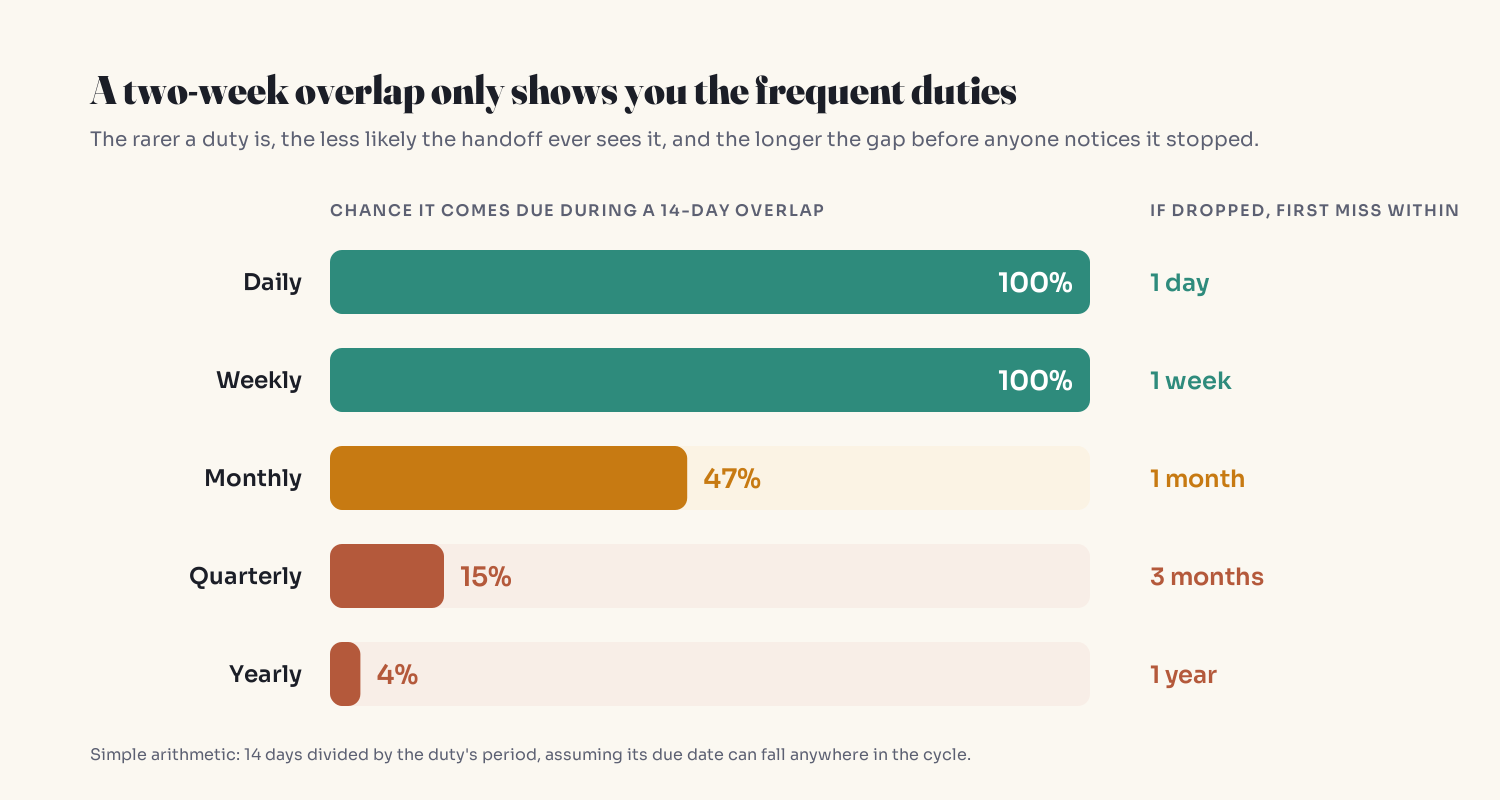
The rows that are least likely to be seen are also the ones that fail latest. A dropped daily task breaks tomorrow, while everyone remembers who left. A dropped yearly renewal breaks after a reorg, when the doc is stale and nobody thinks "handover."
The shape of that failure is well documented even without a handover attached. In December 2018 an expired certificate in Ericsson software knocked out mobile data for roughly 32 million people on O2's UK network. In February 2020 an expired authentication certificate took Microsoft Teams down. Neither was reported as a handover problem. Both are what a dropped Renew looks like.
And renewals are getting more frequent. Under CA/Browser Forum ballot SC-081v3 (April 2025), the maximum lifetime of a public TLS certificate fell from 398 days to 200 days on 15 March 2026, falls to 100 days in March 2027, and reaches 47 days in March 2029. Manual renewal is on its way out regardless of who's leaving.
The handover checklist: six steps
Step 1: Keep a verb log for two weeks
Every time you do something no ticket asked for, add a line: what, what prompted it, how often. Don't filter. "Checked the queue" counts.
Step 2: Sweep the past year for rare duties
Two weeks won't catch quarterly and yearly verbs. Your trail will.
# Your commits from the last year that look like chores
git log --author="you@company.com" --since="1 year ago" --date=short \
  --format="%ad %s" | grep -iE "renew|rotate|bump|rerun|backfill|manual|hotfix"
# Expiry date of a TLS certificate
echo | openssl s_client -connect api.example.com:443 \
  -servername api.example.com 2>/dev/null | openssl x509 -noout -enddate
# Manual interventions you keep repeating
history | grep -iE "restart|rollout|psql|redis-cli|kill"
Then search your calendar for recurring reminders, your inbox for expires, renewal, deprecated, end of life and invoice, and your cloud consoles for key ages and certificate dates. Older commits explain why a chore exists; if you need to dig, git blame often points at the wrong commit, so read the history around it.
Step 3: Convert each verb into a noun (or delete it)
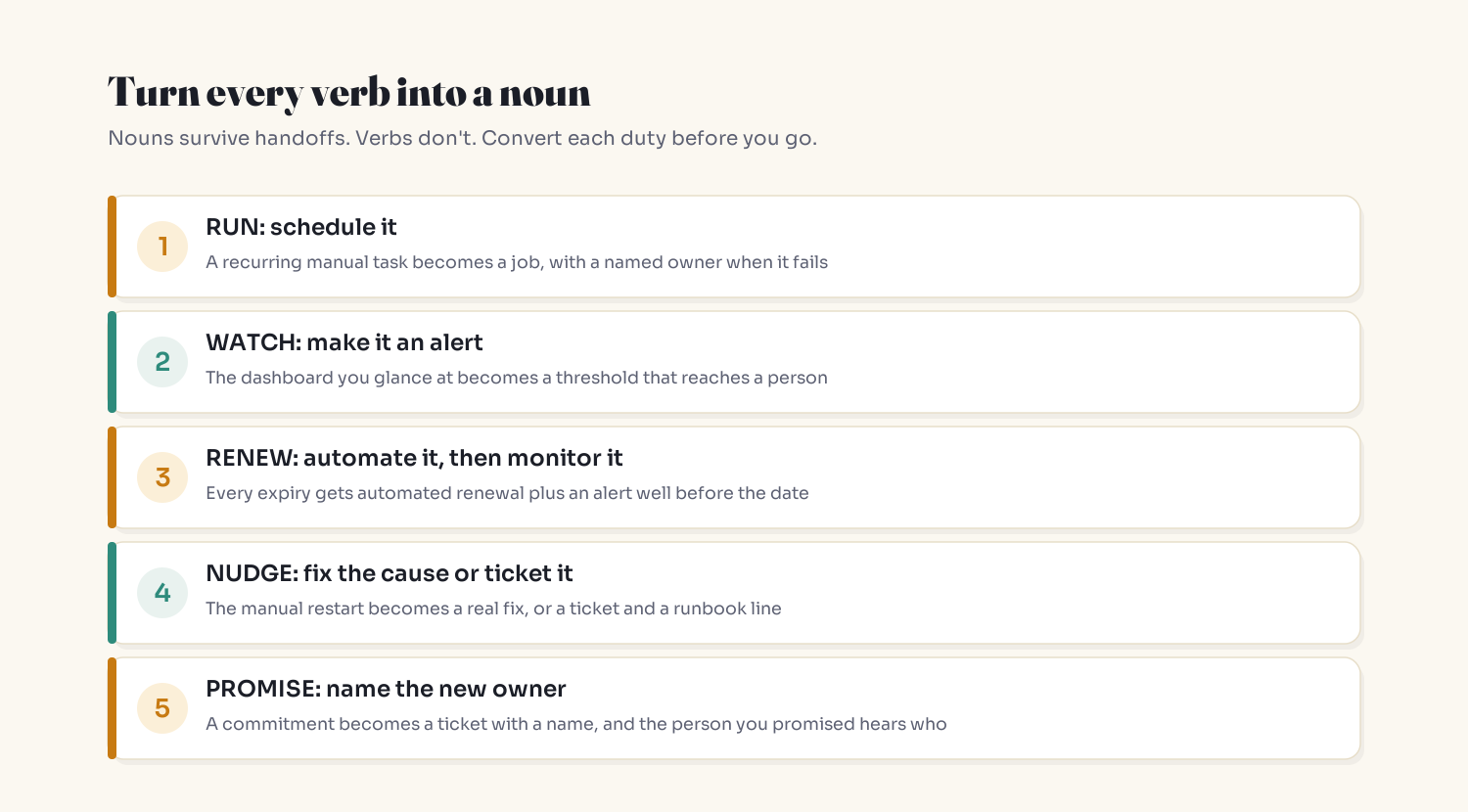
| Verb | Convert to |
|---|---|
| Run | A scheduled job with a named owner who hears about failures |
| Watch | An alert with a threshold that reaches a person (if you can't name the threshold, question the watching) |
| Renew | Automated renewal plus an expiry monitor, since automation fails quietly too |
| Nudge | A fix for the cause, or a ticket and a runbook line: what, when, how you know |
| Promise | A ticket with the new owner's name, and a message from you to the person you promised |
The sixth option is delete. Some verbs exist only because nobody asked whether they're still needed.
Step 4: Have the receiver write the doc
You walk through the verbs; the receiver writes the handover doc in their own words; you correct it. Whatever they can't write clearly, they didn't receive.
Step 5: Reverse the shadow
In the final week the receiver performs every verb that comes due, and you watch without touching the keyboard. This surfaces the steps your hands do automatically.
Step 6: Run the Absence Test, then schedule the long tail
Go quiet for a week before you leave (still reachable for emergencies). Log every routine question instead of answering it instantly. Each one is a verb that didn't transfer.
Then put reminders on the new owner's calendar a few days before each rare verb comes due, plus reviews at 30, 90 and 365 days.
Copy-paste verb register
verb | trigger (date / event / "when I notice") | frequency | what breaks if skipped
     | how you know it's needed | new owner | converted to (job / alert / monitor / ticket / deleted)
     | next due date
FAQ
What should a software project handover document include?
The usual nouns (architecture, repos, deploy steps, access, runbooks, open work) plus a verb register: every recurring task, check, renewal, manual fix and commitment, with its trigger, frequency, new owner and next due date.
How long should a knowledge transfer period be for a developer?
Long enough to cover the frequent duties, but no overlap length catches yearly ones by chance. A two-week overlap has about a 4% chance of seeing a yearly duty, so sweep the past 12 months and calendar the rare verbs instead of relying on overlap.
Why do problems show up weeks after a handover?
Because dropped duties fail on their own schedule. A monthly or yearly task that nobody transferred breaks when it next comes due, which can be long after the person left, so the failure rarely gets traced back to the handover.
What is bus factor, and why isn't it enough?
Bus factor (or truck factor) is the number of people who could leave before a project stalls. It's usually computed from code authorship, so it measures who wrote the system, not who keeps it running through manual duties.
Who should write the handover doc, the person leaving or the person taking over?
The person taking over, with the leaver correcting it. Experts underestimate how much context they leave out (Newton's tapping study: 50% predicted, 2.5% actual), so the receiver's draft shows exactly what didn't transfer.
How do I find tasks I do that aren't documented?
Keep a two-week log of anything no ticket asked for, then sweep a year of history: commits mentioning renew, rotate or rerun; shell history for restarts and manual SQL; calendar reminders; inbox searches for "expires" and "renewal"; cloud console expiry dates.
Related reading
- Your Best Work Erases Its Own Evidence: why prevention work goes unseen, and why a verb register is evidence.
- The 3-Line Diff That's Harder to Undo Than Your Rewrite: how temporary workarounds turn into permanent duties.
- git blame Is Pointing at the Wrong Commit: reading history to understand code you inherit.
- Your Career Isn't Measured in Code. It's Measured in Blast Radius.: why people whose duties are written down get trusted with more.
- New here? Start Here: A Plain-English Map to Understanding AI
The bottom line
A handover isn't the meeting where you walk someone through the doc. It's the moment the last duty stops depending on you. The doc tells the next person what the system is. The verb register tells them what it needs, and when.
You were a cron job nobody wrote down. Write it down before you go.
Adam Jaber is a software engineer who writes Simply Explained: complex topics, made simple, no jargon, no hype.
Keep reading: New here? Start Here: A Plain-English Map to Understanding AI
📬 Get one of these in your inbox each week → Simply Explained newsletter
About the author
- I'm a senior software engineer. I write Simply Explained, a plain-English breakdown of how AI and software actually work, and the quiet ways they break: AI fixes that hide bugs, agents that pick the wrong tool, health checks that take down healthy servers. One symptom, one analogy, one fix per piece. New here? Start with the pinned Start Here guide, or get one breakdown a week by email.
Comments
Join the discussionNo comments yet. Be the first to comment.