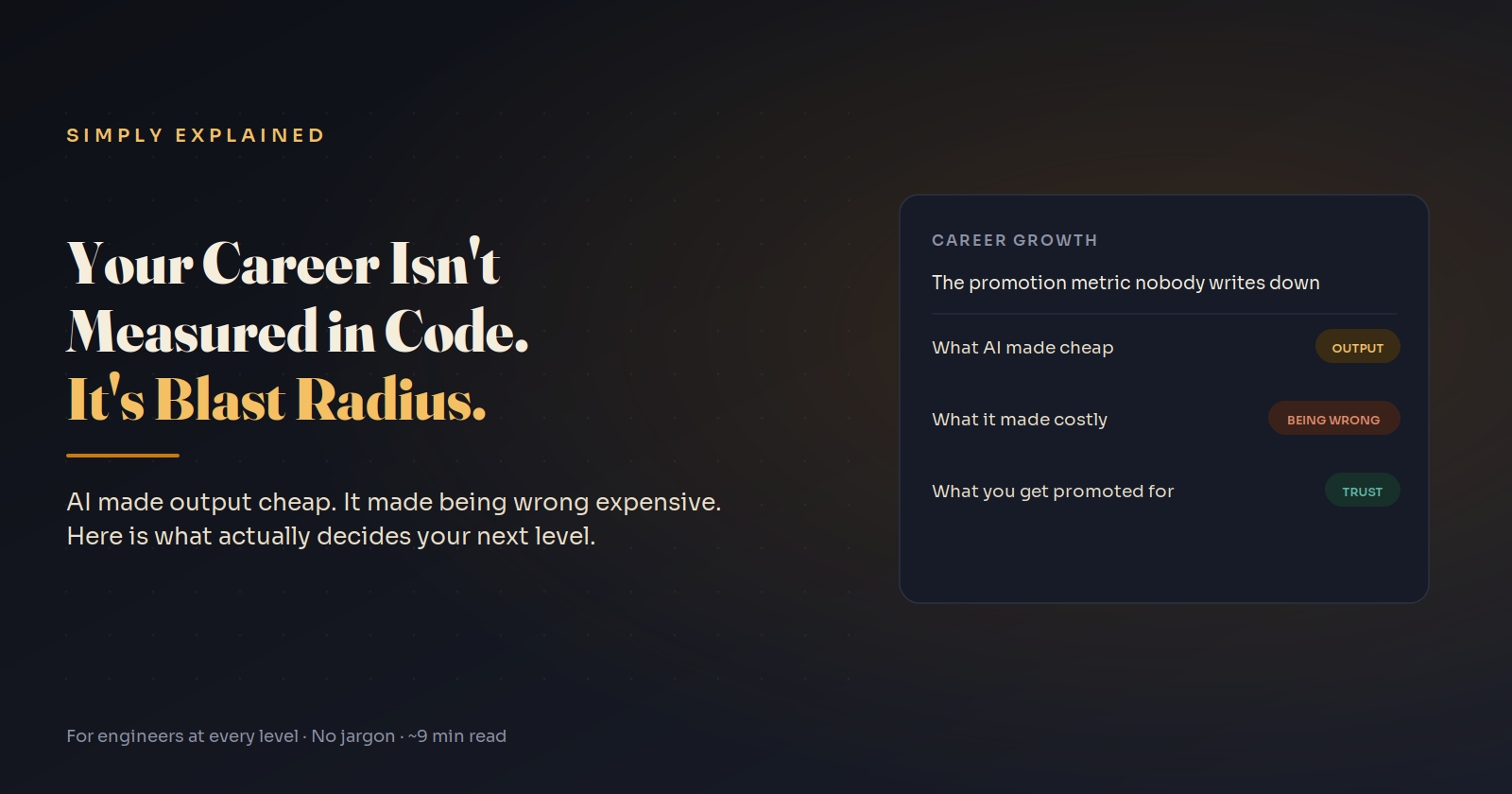
Your Career Isn't Measured in Code. It's Measured in Blast Radius.
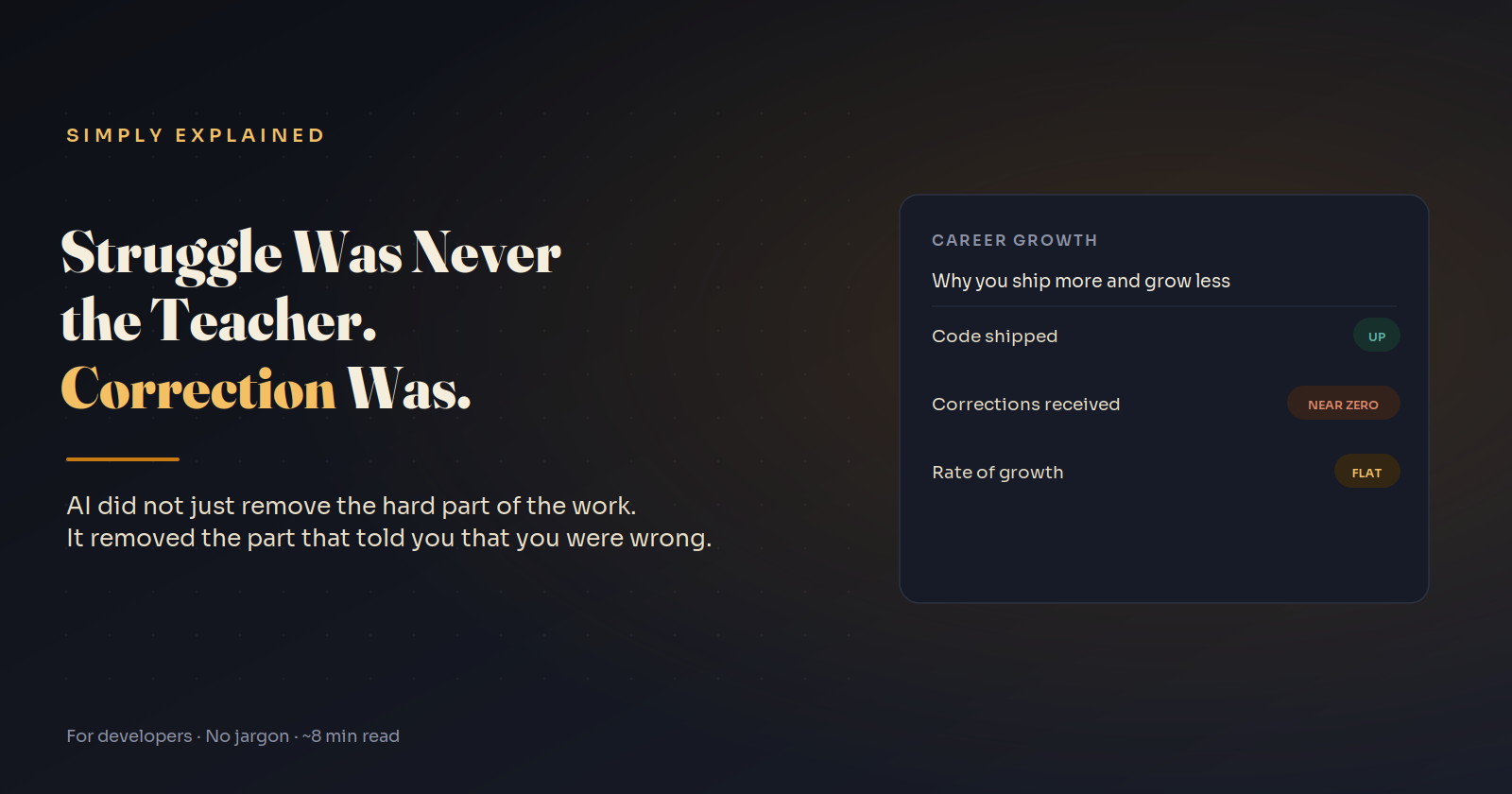
AI made writing software cheap. The metric that decides your next level was never output.
Two engineers join the same team in the same month. One of them takes to AI tools immediately and closes tickets faster than anyone expected. The other is slower, asks a lot of questions in review, and spends a full day on a two-hour migration because he wanted to know what happened to the rows that failed halfway through.
Eighteen months later, he is on call for the payments service and she is still being handed well-defined tickets.
That outcome looks unfair until you know what is actually being measured.
The metric nobody writes down
Engineers already have the right word for it, borrowed from incident response and cloud permissions: blast radius. When something fails, how far does the damage travel? We design systems specifically to keep that radius small.
Careers work the same way. Your level is not a measure of what you can build. It's a measure of how large a mistake your employer is willing to let you make.
Seniority isn't the size of the problem you can solve. It's the size of the mistake you're allowed to make.
Mechanically, a promotion is somebody with authority deciding they can sleep at night while you make a class of decision without checking in. The title is documentation of a risk somebody chose to absorb on your behalf.
Two prices flipped at the same time
For most of this profession's history, output was a fair proxy for judgment. Producing working software was slow and expensive, so if you shipped something complex, you had almost certainly understood it. Output and understanding traveled together.
That link is broken.
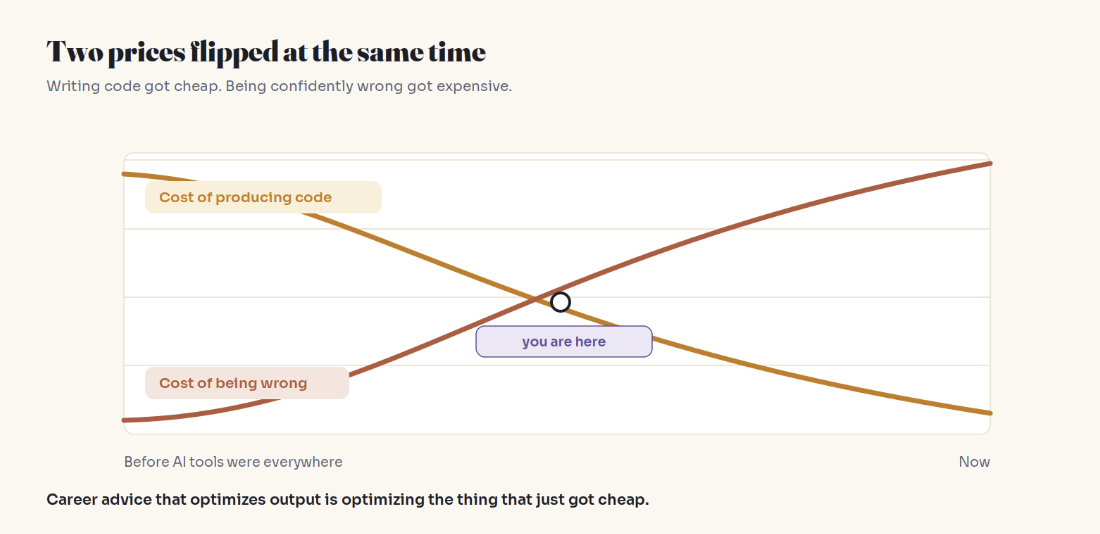
The cost of producing code collapsed. The cost of being confidently wrong went up, because there is now more code moving through review, written faster than anyone can carefully read, by a tool that has no idea when it is guessing.
Output was never the bottleneck. Trust was. AI removed the bottleneck nobody was stuck on.
The hiring data points the same direction, even though studies disagree on magnitude. Stanford researchers working from payroll records found employment for workers in their early twenties fell relative to older workers in the same AI-exposed occupations. Indeed's Hiring Lab found most of the recent recovery in software postings came from senior roles. This isn't "AI replaced programmers." It's a market that stopped paying for volume and started paying for judgment.
Why "be 10x with AI" is bad career advice
If output is cheap, being unusually good at producing output buys you unusually little. You'd be competing at the commoditized thing, against a tool that never sleeps.
The strategy also backfires. The faster you ship code you didn't fully reason through, the more review time you consume from the senior people whose trust you're trying to earn. If reviewing your work takes longer than the work itself, you are not a productive engineer — you are load.
That's not an argument against the tools. It's an argument about what you point them at: move fast through the parts that carry no consequence, and buy time for the parts that do.
The ladder, honestly labeled
Strip the titles off a career ladder and label each rung by what breaks when you get it wrong.
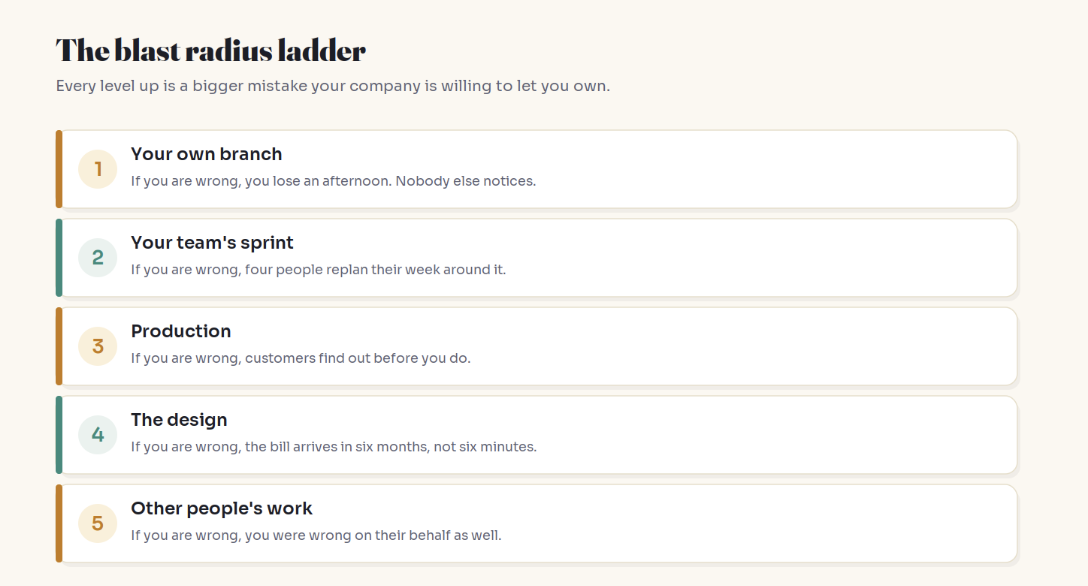
Not one rung is about difficulty. You can solve genuinely hard problems on rung one for three years and never move. You can reach rung three by owning something small and boring that touches real customers.
And nobody hands you the next rung as a reward. It's granted in advance, on a prediction: that when this breaks at 11pm, you'll notice, understand, and handle it. Everything you do is evidence for or against that prediction.
AI makes it easy to look senior and harder to become senior
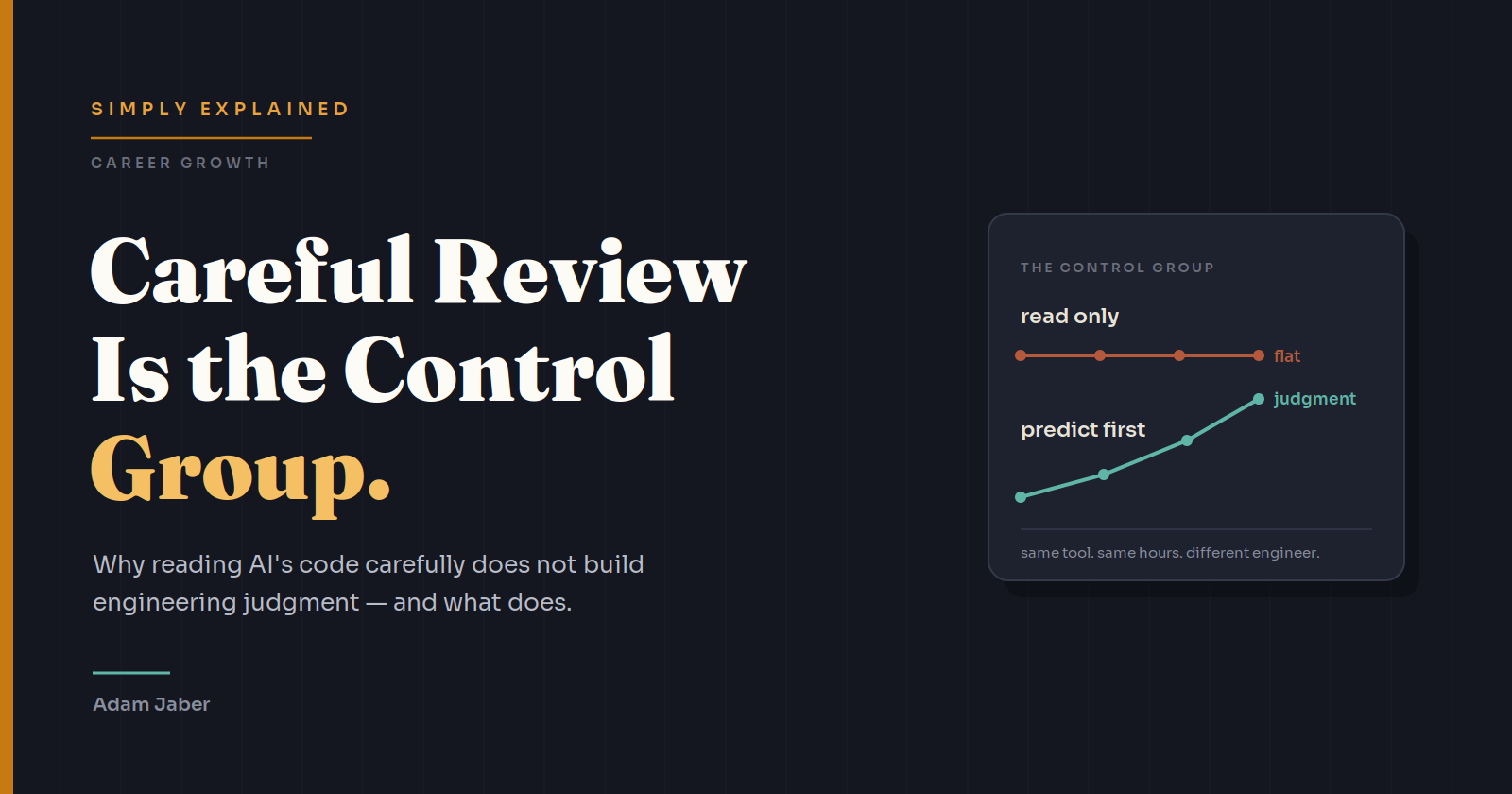
The old path to seniority ran through boring work — CRUD endpoints, flaky tests, data backfills, log files at 2am. It felt like a waste of a degree. It was the curriculum. Each task quietly taught you what breaks, in what order, and how it announces itself.
That work is exactly what got automated first. The apprenticeship has been partially deleted at the level where people used to enter.
In its place, AI hands you something that looks like the end state: architecture-shaped answers and confident explanations of systems you have never operated.
AI gives you senior-looking output with junior-level understanding. The gap only shows up when something breaks.
This is why AI fluency alone gets nobody promoted. Everyone has it. What's scarce is the person who used AI and can still explain, under questioning, why it works, what it assumed, and what happens when the assumption fails.
Chase consequence, not complexity
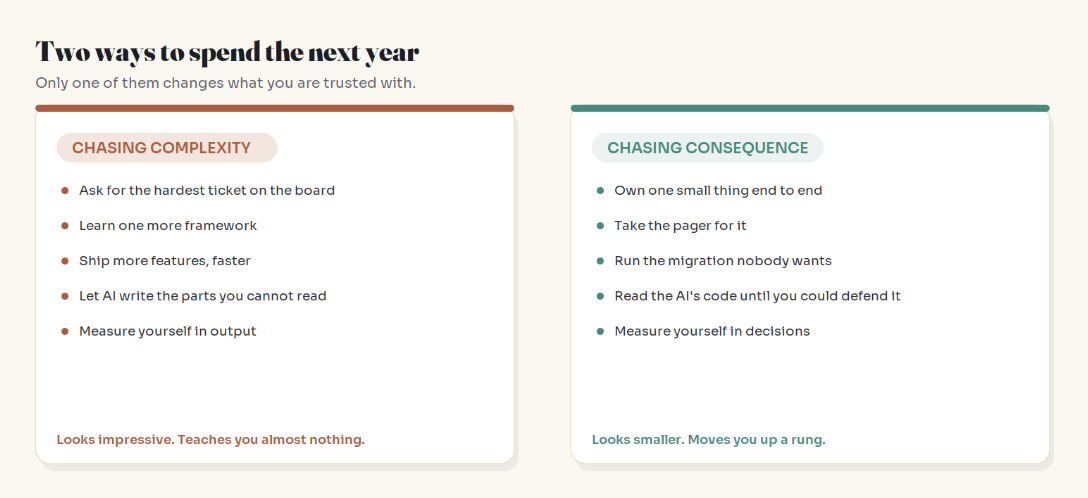
Chasing complexity means the hardest ticket on the board, another framework, more shipped features. Flattering, and it produces a resume that reads well attached to a career that doesn't move.
Chasing consequence means asking for something small that is load-bearing and staying attached to it. Own the endpoint and its alerts. Take the pager. Volunteer for the migration nobody wants, because migrations are where consequences live. Read the AI's output until you could defend every line in a design review, and refuse to merge what you can't.
Then stay for the whole incident. Don't just apply the fix somebody handed you — find out why it happened, write it down, tell people. Incidents are the fastest teacher in this industry and most engineers sprint away from them.
Early career: aim where consequences are legible and human review is mandatory — regulated industries, old systems with real business rules, infrastructure, anything with compliance attached. Those organizations onboard humans because their systems can't onboard themselves.
Already senior: the scarce resource on your team is verified understanding, not code. Review for comprehension, not just correctness — ask what happens when this fails. And notice that automating away every low-consequence task also automates away your only training ground for the next generation.
Key Takeaways
Your level equals the size of the mistake you're trusted to make, not the difficulty of the work you can do.
AI collapsed the price of producing code and raised the price of being confidently wrong.
Career advice that optimizes output is optimizing the thing that just got cheap.
The blast radius ladder: your branch, your team's sprint, production, the design, other people's work.
AI produces senior-looking output with junior-level understanding; the gap surfaces during incidents.
Growth comes from chasing consequence (ownership, pager, migrations, postmortems), not complexity.
Diagnostic question: what am I currently trusted to be wrong about?
FAQ
How do you become a senior software engineer in the AI era?
By expanding what you are trusted to be wrong about. Take ownership of something small but load-bearing, stay attached to it through failures, and be able to defend every decision — including the ones an AI tool suggested — under questioning.
Is AI replacing junior developers?
Not as a job category, but it has automated much of the low-judgment work that used to justify hiring one. Stanford payroll research found early-career workers in AI-exposed occupations lost ground relative to older workers in the same roles, and Indeed's Hiring Lab found the recent rebound in software postings skewed senior.
What actually gets a software engineer promoted?
A decision by someone with authority that they can stop supervising a class of your work. Titles document absorbed risk. That's why scope and ownership matter more than lines of code or tickets closed.
Does being more productive with AI help your career?
Only if you spend the saved time on understanding. AI fluency is now a baseline like version control, not a differentiator. Shipping more code you can't fully defend transfers review burden onto senior engineers and makes you harder to trust.
Why is it harder for juniors to gain experience now?
The traditional apprenticeship ran through low-stakes repetitive work — backfills, flaky tests, small bug fixes — which is exactly what AI tools absorbed first. The learning path was accidentally removed along with the tasks.
What should a junior developer do to get hired in 2026?
Target roles where mistakes are expensive and human review is mandatory: regulated industries, finance, healthcare, infrastructure, and companies with large legacy systems. Demonstrate owned outcomes — something you ran end to end and can explain when it failed — rather than volume of projects.
Related reading
AI Writes Code That Looks Right — the same understanding gap, seen from inside a pull request.
AI Won't Take Your Coding Job. It Will Change It. — what the job inverts into when verification becomes the work.
Everyone's Building AI Agents. Almost No One Will Trust Them. — the same trust ladder, applied to software instead of people.
Why AI Confidently Lies — why review burden went up in the first place.
The Basics of AI— A Beginner’s Guide to How Artificial Intelligence Actually Works.
Start Here — the full Simply Explained map.
The bottom line
If you want one diagnostic for where your career stands, it isn't "what can I build?" It's "what am I currently trusted to be wrong about?" Whatever the honest answer is, that's your level — not your title, not your tooling, not last quarter's pull request count.
You don't climb by taking on more complexity. You climb by taking on more consequence.
AI didn't change that rule. It removed everything that used to hide it.
Adam Jaber is a software engineer who writes Simply Explained — complex topics, made simple. No jargon, no hype.