Everyone's Building AI Agents. Almost No One Will Trust Them.
AI agents are a real breakthrough — and expensive, unreliable, and hard to control at the same time. Here's why, and the autonomy framework that makes them actually usable.
2026 is "the year of the agent." The demos are jaw-dropping. But there's a gap between a demo that dazzles and a system you'd let touch production — wider, more expensive, and more uncomfortable than the hype admits. Here's the honest engineering reality, and the one framework that makes agents usable.
You've seen the demo: give an AI agent a one-line goal and it just goes — searches, reads, takes notes, writes a report, on its own. It looks like magic. Then you build one for real and hit the gap nobody mentions: it loops forever on a trivial task, burns $40 of API calls to do $4 of work, and occasionally takes an action you can't undo. The demo was easy. Trusting it is the hard part.
Agents are a genuine breakthrough and they're expensive, unpredictable, and hard to control — at the same time. Understanding why is what separates teams that ship useful agents from teams with an impressive demo and a scary bill.
What actually changed: the loop
A chatbot answers a question and stops. An agent wraps a language model in a loop with tools it can call: it takes a goal, plans a step, acts, observes, and repeats until the job is done. That loop turns a thing that talks about doing something into a thing that does it — and it's also the source of every problem that follows.
A chatbot is a model that answers. An agent is a model that acts, in a loop, on its own. Everything wonderful and everything terrifying about agents comes from that one difference.
Why AI agents get so expensive
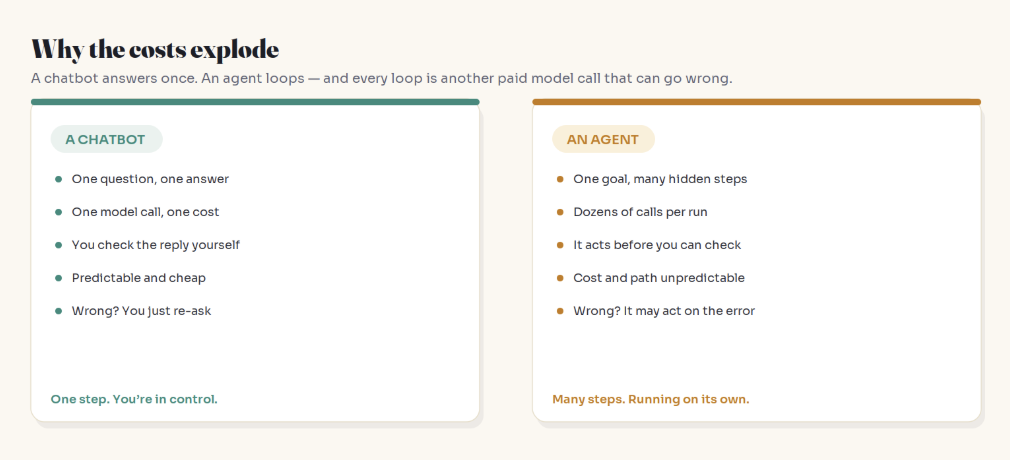
With a chatbot, one question is one model call. An agent shatters that: a single goal becomes dozens of calls as the loop churns — plan, call a tool, read the result, re-plan, repeat. Each turn is a paid API call, and one "run" is however many loops the agent decides it needs — a number you don't know in advance.
Worse, on every step the agent re-reads its entire accumulated history to decide what's next, so each step gets more expensive as the context grows. A task that wanders can quietly cost 10× your estimate.
With a chatbot, you pay per question. With an agent, you pay per decision — and the agent, not you, decides how many decisions it needs.
Why AI agents are so unreliable
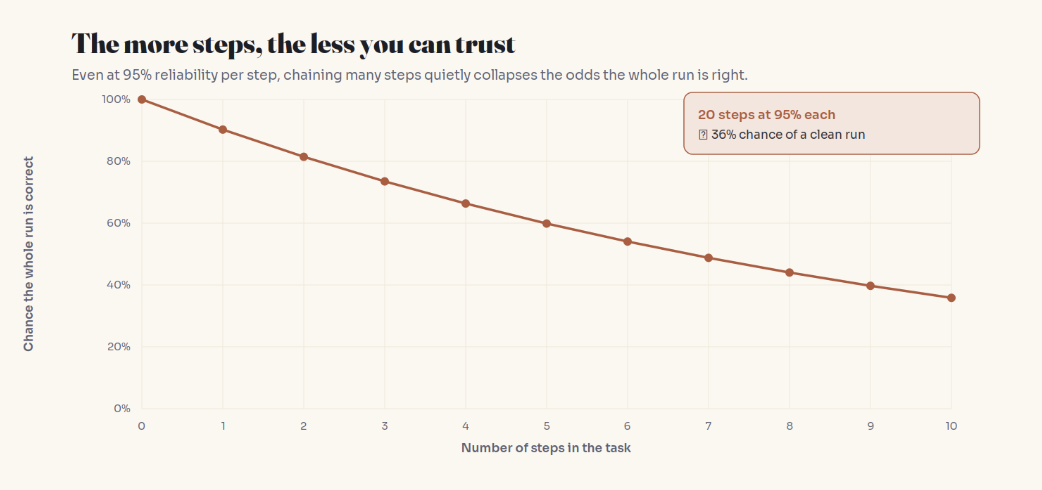
Say each step is 95% reliable — genuinely good. But steps chain, and probabilities multiply. Two steps: ~90%. Ten steps: ~60%. Twenty steps at 95% each: roughly a 36% chance the whole run is clean. (This is the same compounding effect behind why AI agents fail.)
And it's worse than the numbers suggest, because an agent acts on its failures. A chatbot's wrong answer is one you can see and ignore. An agent that misreads a result takes its next action based on that misreading, compounding a small early error into a confident, elaborate, wrong sequence.
A chatbot's mistake is a bad sentence. An agent's mistake is a bad action — followed by more actions built on top of it.
Why "just supervise it" doesn't scale
The obvious fix is to have a human check the agent's work. But that kills the value proposition: if you review each of 20 steps, you haven't saved labor — you've added the overhead of reading an AI's reasoning on top of the work you were avoiding.
An agent you have to watch constantly isn't saving you time. An agent you don't watch will eventually do something you deeply wish you'd watched.
There's also a security dimension: because an agent acts on text it reads, a malicious instruction hidden in a page or document can hijack it — the prompt injection problem. An unsupervised agent with real power is also an attack surface.
The real question: how much autonomy?
The question is never "agent or not?" It's how much autonomy do I give it? Autonomy is a slider, and setting it correctly for the task is the whole art.
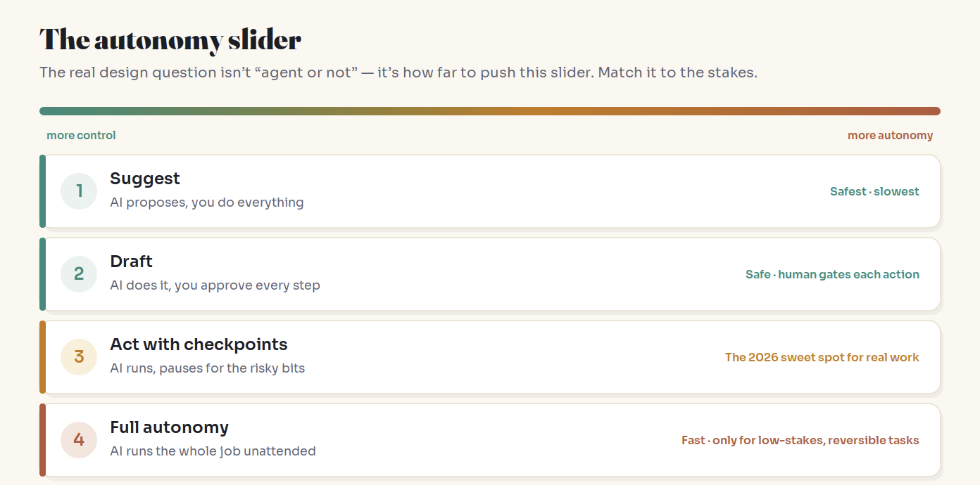
1. Suggest — the AI proposes, you act. Safest, slowest; nothing happens without you.
2. Draft — the AI acts, you approve each step. Safe, but on many-step tasks it can cost as much attention as doing it yourself.
3. Act with checkpoints — the AI runs the low-stakes steps and pauses for you at the consequential ones (spending money, deleting, emailing out). The 2026 sweet spot where most useful agents live.
4. Full autonomy — the AI runs unattended. Reserve for genuinely low-stakes, reversible tasks where a wrong action is cheap to undo.
Set the autonomy slider to match the cost of a mistake, not the coolness of the demo. Cheap and reversible → let it run. Expensive or irreversible → keep a human on the trigger.
Where agents genuinely shine in 2026
Aim them at bounded, repetitive, multi-step tasks where mistakes are cheap and checkable: research and synthesis, data cleanup, first-draft customer replies a human approves, clicking through an app to file bug reports. In each, the agent does the tedious legwork, per-step stakes are low, and a human reviews the output before it counts.
The teams winning with agents in 2026 didn't hand them the keys. They picked one boring, bounded, reversible task and pointed a well-supervised agent at it.
Key Takeaways
An agent is a language model in a loop with tools — it acts, observes, and repeats autonomously.
Agents are expensive because one goal becomes dozens of paid model calls, and cost compounds as context grows.
They're unreliable because step reliabilities multiply (20 steps at 95% ≈ 36%), and agents act on their own errors.
Full supervision kills the value; the fix is the autonomy slider — match autonomy to the cost of a mistake.
Most real value sits at "act with checkpoints": autonomous on low-stakes steps, human approval on consequential ones.
FAQ
Why are AI agents so expensive to run?
Because one goal becomes many model calls. Unlike a chatbot (one question, one call), an agent runs a loop — plan, act, observe, repeat — and each iteration is a paid API call. It also re-reads its growing history on every step, so cost compounds as the task lengthens. Because the number of steps isn't known in advance, agent costs are hard to predict and can far exceed estimates.
Why are AI agents unreliable?
Because steps chain and probabilities multiply. Even at 95% reliability per step, a 20-step task has only about a 36% chance of completing cleanly. Worse, an agent acts on its own errors: a misread result leads to a wrong next action, compounding a small early mistake into a confidently wrong sequence of actions rather than a single visible error.
How much autonomy should I give an AI agent?
Match autonomy to the cost of a mistake. Low-stakes, reversible tasks can run fully autonomously; expensive or irreversible actions should require human approval. Most real-world value sits at "act with checkpoints," where the agent runs routine steps itself but pauses for a human before consequential actions like sending money, deleting data, or emailing customers.
What is the difference between an AI agent and a chatbot?
A chatbot responds to a single prompt and stops — one model call, one answer. An agent wraps a model in a loop with tools, so given one goal it takes many steps — planning, acting, observing, and adapting — until the task is done. The loop and tool access are what let an agent do things autonomously rather than just talk about them.
What tasks are AI agents actually good at in 2026?
Bounded, repetitive, multi-step tasks where mistakes are cheap and checkable: research and synthesis, data cleanup and normalization, drafting customer replies for human approval, and automated testing/QA. The common thread is low per-step stakes and a human reviewing the final output before it matters — not open-ended, high-stakes, irreversible work.
Can AI agents be trusted to work fully autonomously?
Only for a narrow set of tasks: those that are low-stakes and reversible, where any single wrong action is cheap to undo and can't cause real harm. For anything expensive, irreversible, or high-stakes, full autonomy is risky because agents fail in compounding ways and act on their mistakes. The safer default is autonomous execution with human checkpoints at the consequential steps.
Related reading
How AI Learned to Actually Do Things — the tool-calling loop that every agent is built on.
Why AI Agents Fail in the Real World — the compounding-error math in depth.
The AI Security Hole You Can't Patch — prompt injection, why unsupervised agents are an attack surface.
The bottom line
AI agents are real and transformative — but the hard part was never the demo. It's deciding how much to trust a system that's expensive to run, unreliable in a compounding way, and capable of acting on its own mistakes. The teams that succeed set the autonomy slider thoughtfully, match it to the cost of being wrong, and keep a human on the decisions that matter.
The future belongs to agents. But specifically, it belongs to the people who know exactly how long a leash to give them.
I'm a software engineer writing about AI and the systems behind it, minus the jargon. Follow along for the next one.