Predict Before You Prompt: How Junior Developers Actually Get Good in the AI Era
AI didn't take your reps. It made them optional — and skipping them is why you ship more and learn less.
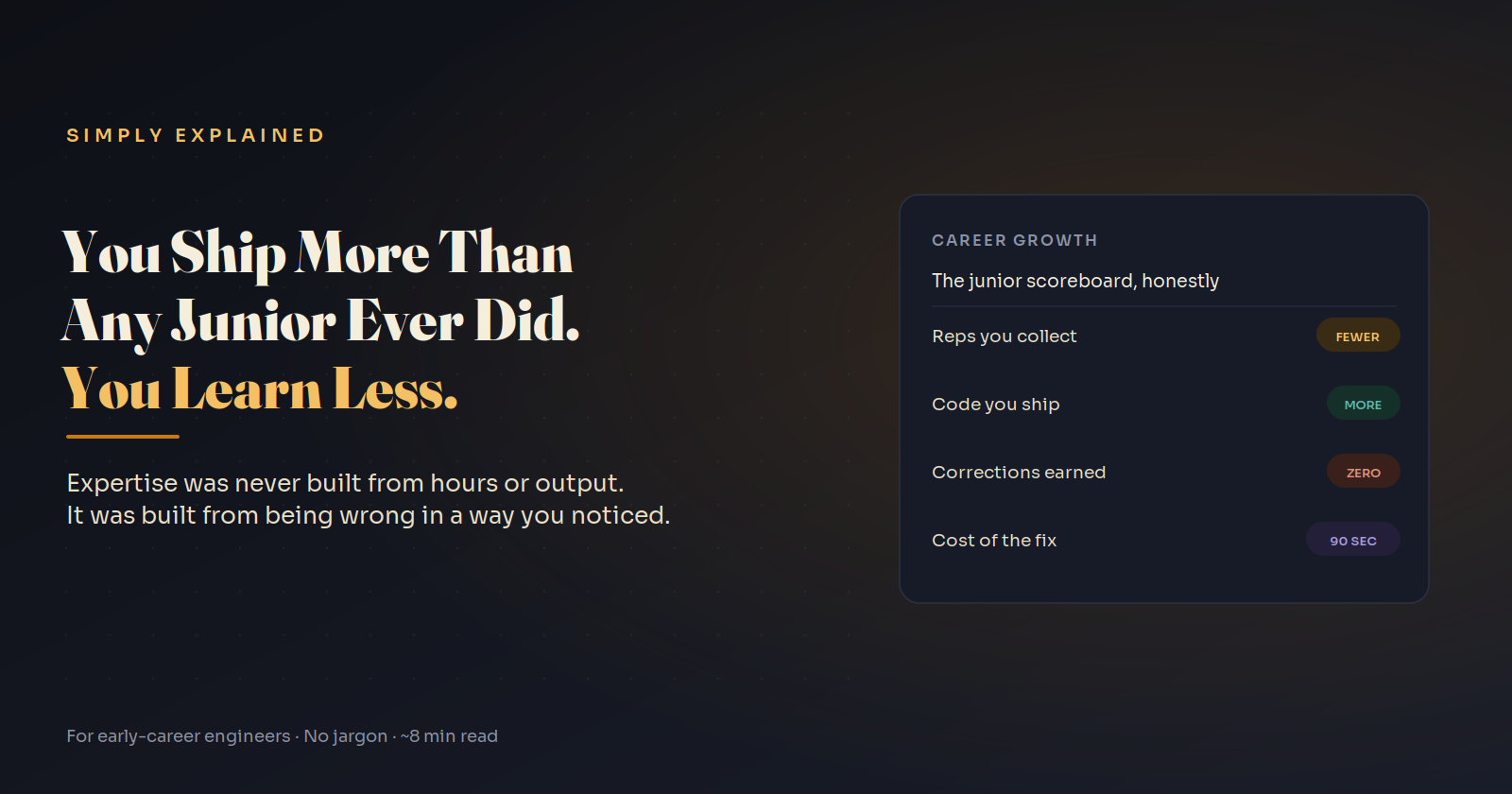
Picture a developer six months into her first job with forty merged pull requests behind her. Real features, reviewed and deployed. By every metric her team tracks, she is doing fine.
Then a senior asks, in passing, why she wrapped a particular block in a transaction. He is just curious.
She has nothing. Not a wrong answer — no answer. The code is correct. She wrote the prompt, read the output, understood it well enough to review it, and shipped it. She never held a belief about it that could be right or wrong.
That gap is what the entire "AI killed the junior developer" argument keeps missing.
The argument everyone is having
Entry-level postings have fallen hard since 2022 and companies increasingly expect juniors to arrive pre-trained. One camp says AI ate the entry-level job. Another says the economy did it and AI became the convenient explanation. A third says juniors should move up the value chain and review instead of write.
The version that has taken over recently is sharper: AI didn't take the junior job, it took the apprenticeship. The boring CRUD work was the training ground, and automating it stops the industry from manufacturing seniors.
That's closer. It's still wrong about the mechanism, in a way that matters if you're the junior.
The grunt work never taught anyone anything. It just happened to be where the corrections lived.
Expertise is corrected predictions, not hours
Nobody got good by writing their four hundredth CRUD endpoint. Endpoint four hundred taught nothing endpoint twelve hadn't.
What the old grind physically forced on you was different. You guessed where the bug was and the stack trace corrected you. You guessed the query was fast and production corrected you. You guessed your approach was reasonable and a senior left a comment starting with "why not just—".
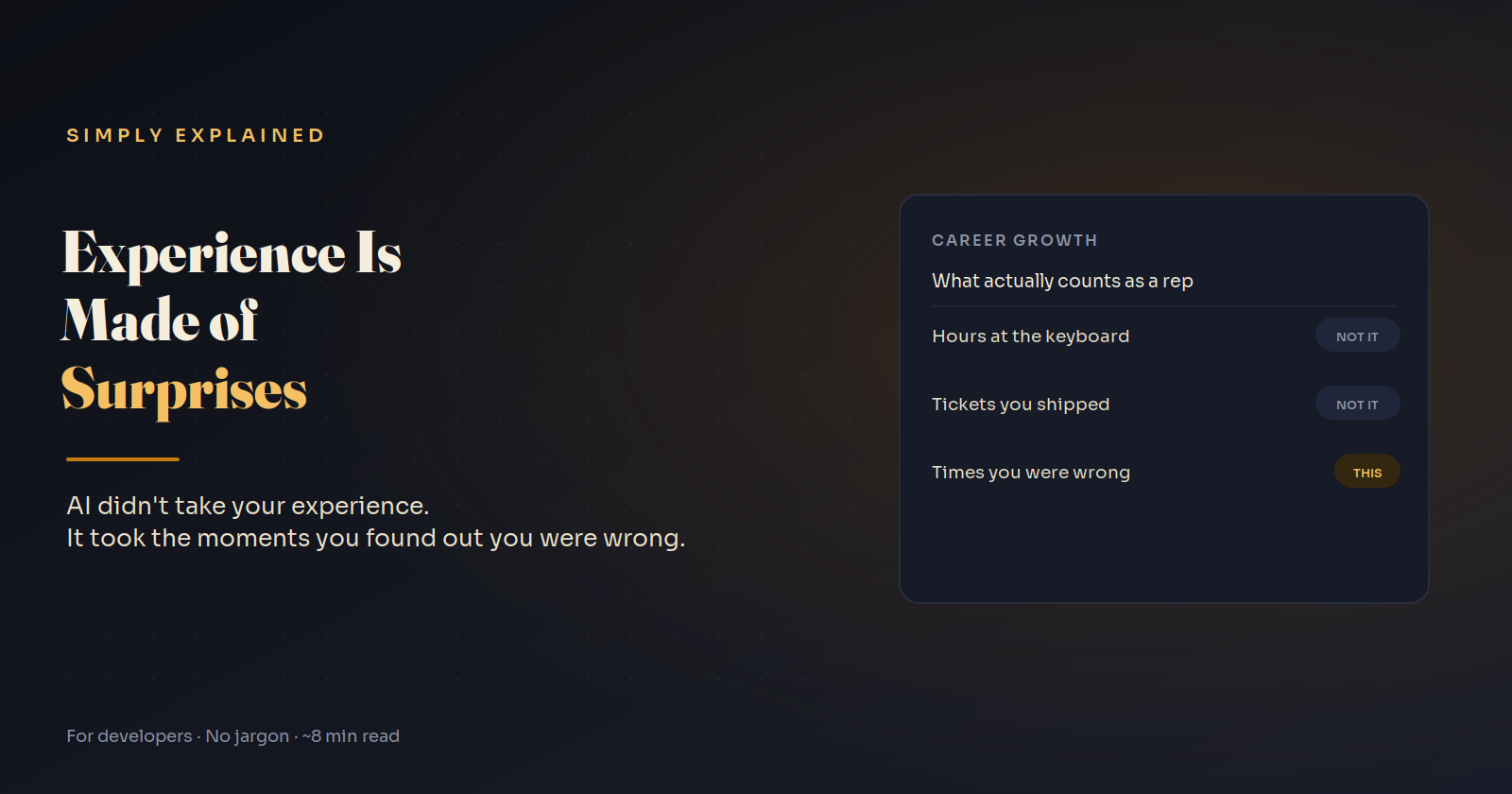
Every one of those is the same event: a prediction, followed by a correction. That is the unit of expertise. Not the hour, not the ticket, not the line.
And the grind was a terrible delivery system for it — slow, expensive, and rationed by how patient your senior felt that sprint. Maybe a couple of real corrections a week.
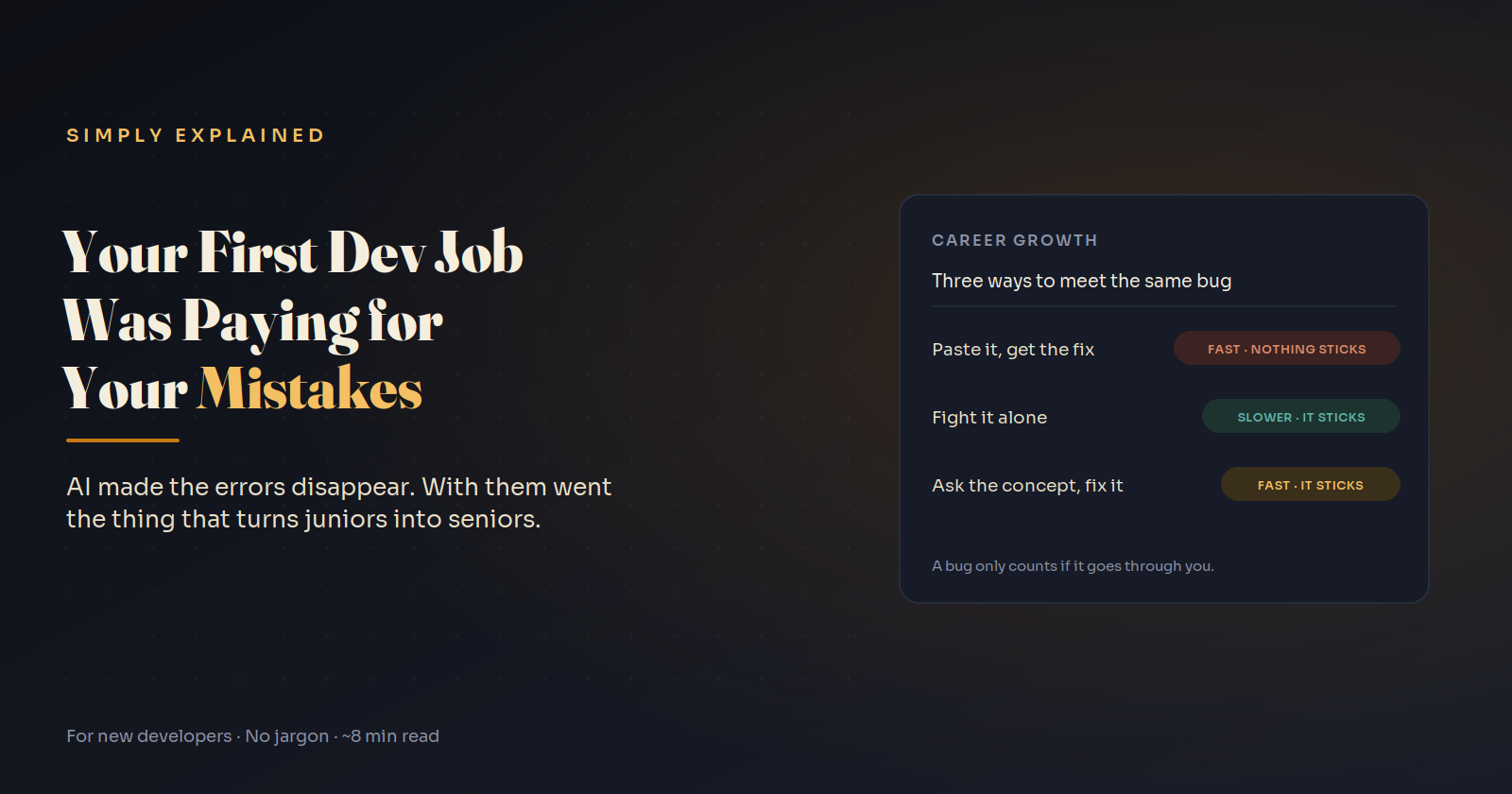
So the apprenticeship people are mourning a machine that produced two corrections a week at enormous cost. The actual problem is that its replacement produces zero by default, while feeling dramatically more productive.
Why prompting produces zero corrections
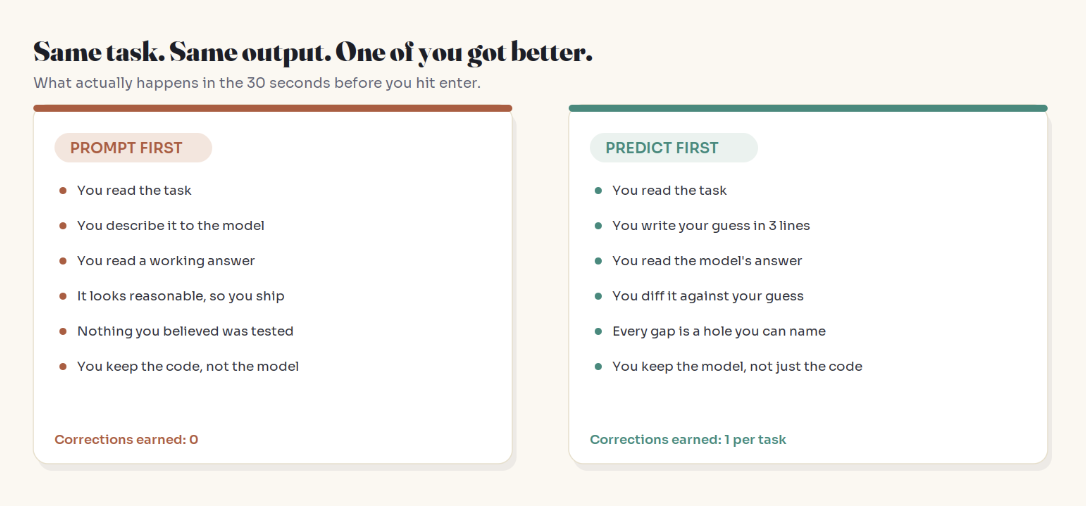
Prompt-first work goes: read the task, describe it to the model, read back something that works, sanity-check, ship.
Nothing there tested a belief, because none was formed. The information was all present — the approach, the edge cases, the tradeoffs — but it arrived as an answer instead of a surprise, and answers slide off.
You cannot be corrected on a prediction you never made.
This isn't laziness. It's the default path, and taking the answer is the rational move most of the time. It also explains the complaint I hear from early-career engineers almost word for word: I'm shipping more than ever and I don't feel like I'm getting better. That's not imposter syndrome. That's an accurate reading.
One mechanism, six symptoms
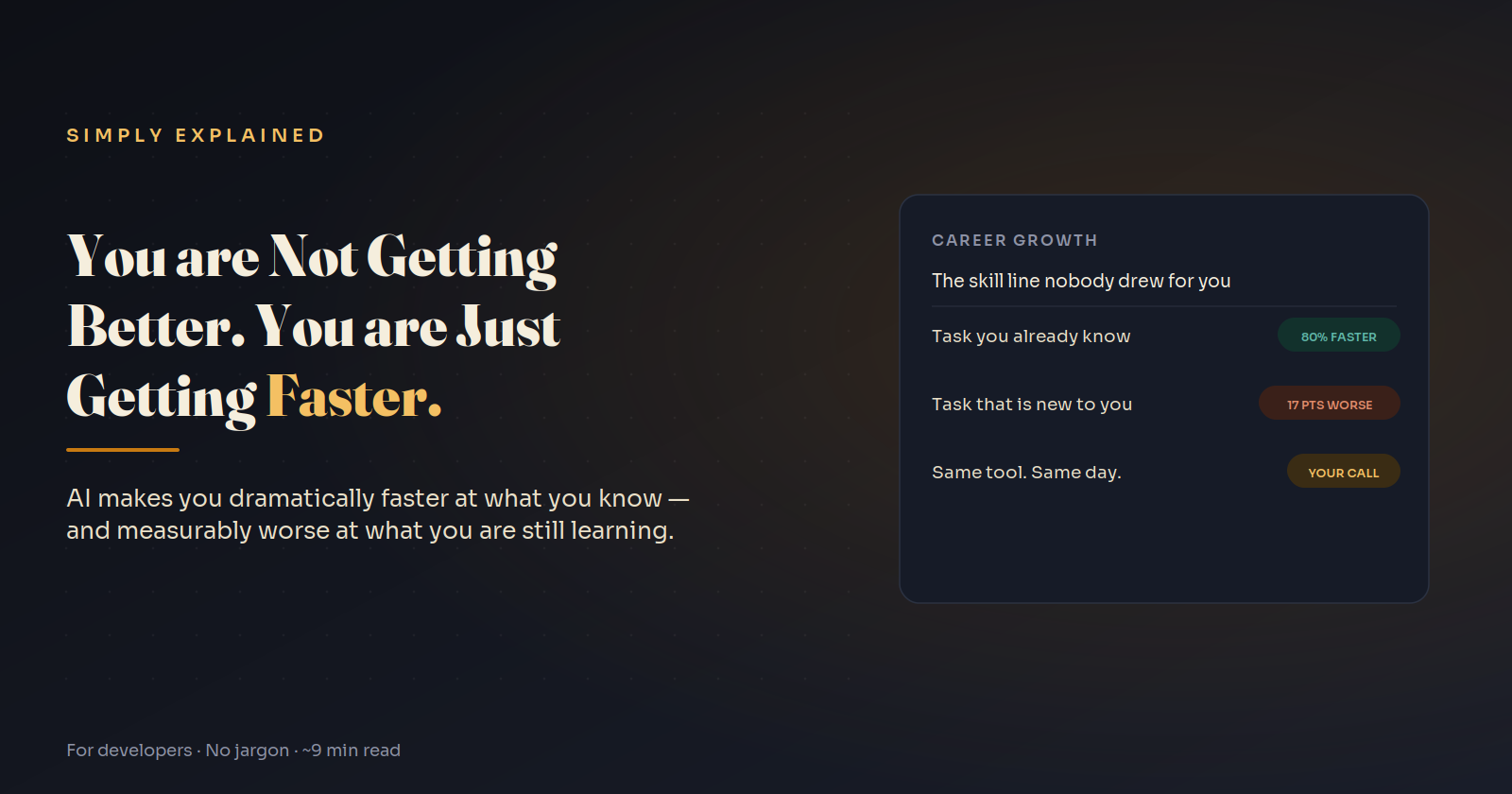
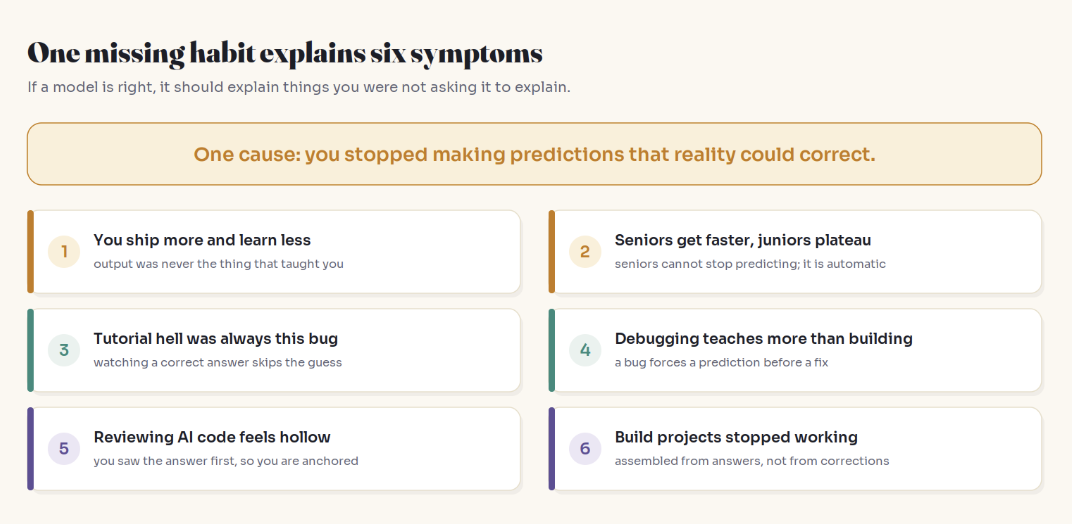
Seniors get more from AI than juniors do. Not better prompting — they physically cannot read a diff without predicting it first. Every interaction hands them a free correction. The same interaction hands a junior none.
Tutorial hell was always this bug. Watching someone build the app is pleasant and useless because the answer arrives before your guess.
Debugging teaches more than building. A bug forces a theory, then tests it immediately. It's the highest-density correction source we have.
Reviewing AI code feels hollow. You review after seeing the answer, so you're anchored — which is exactly why AI code that looks right survives review.
"Just build projects" stopped working. A portfolio assembled from answers is code you can't defend, and the interview question is now the senior's question: why this way?
The job is inverting toward verification while the industry dismantles the only known method of producing it. Verification is a prediction. Without one, you can't verify — you can only agree.
The 90-second loop
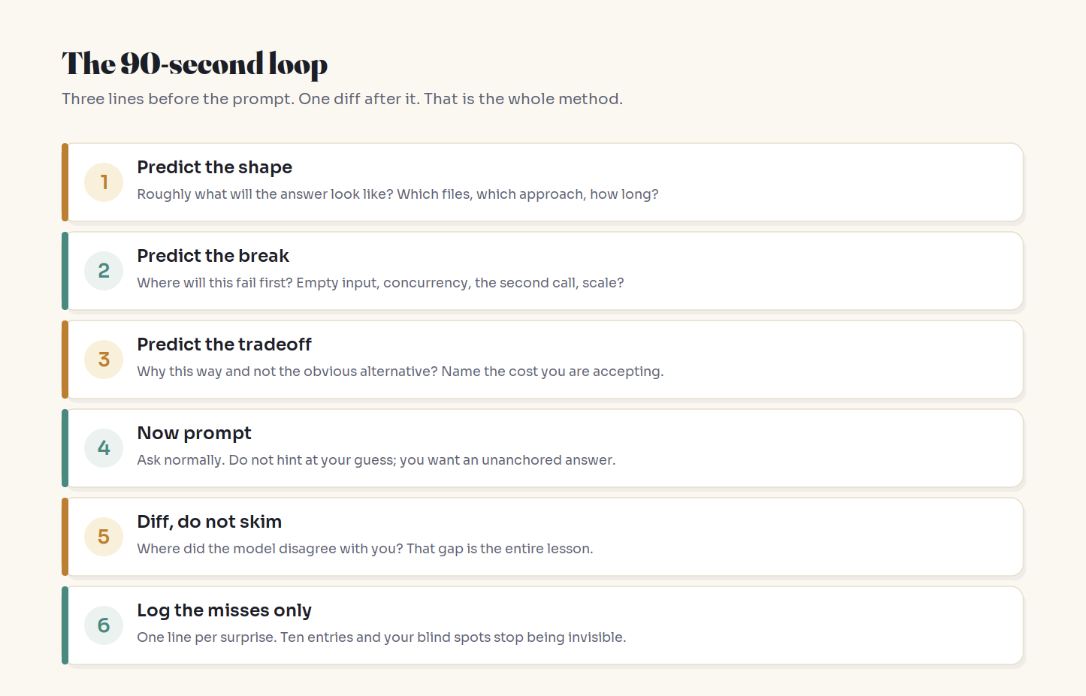
Write your guess down before you hit enter. Three lines, in a scratch file:
Shape — what will the answer look like? Which files, which approach, roughly how long?
Break — where does this fail first? Empty input, concurrency, the second call, scale?
Tradeoff — why this way and not the obvious alternative? Name the cost you're accepting.
Then prompt normally. Don't paste your guess in — you want an unanchored answer, not agreement. When it returns, ask the only question that matters: where did it disagree with me, and why?
Most of the time you'll be roughly right on shape and badly wrong on break. That pattern is the useful one: your model of how things work is fine, your model of how things fail is thin. That gap is the distance between junior and senior.
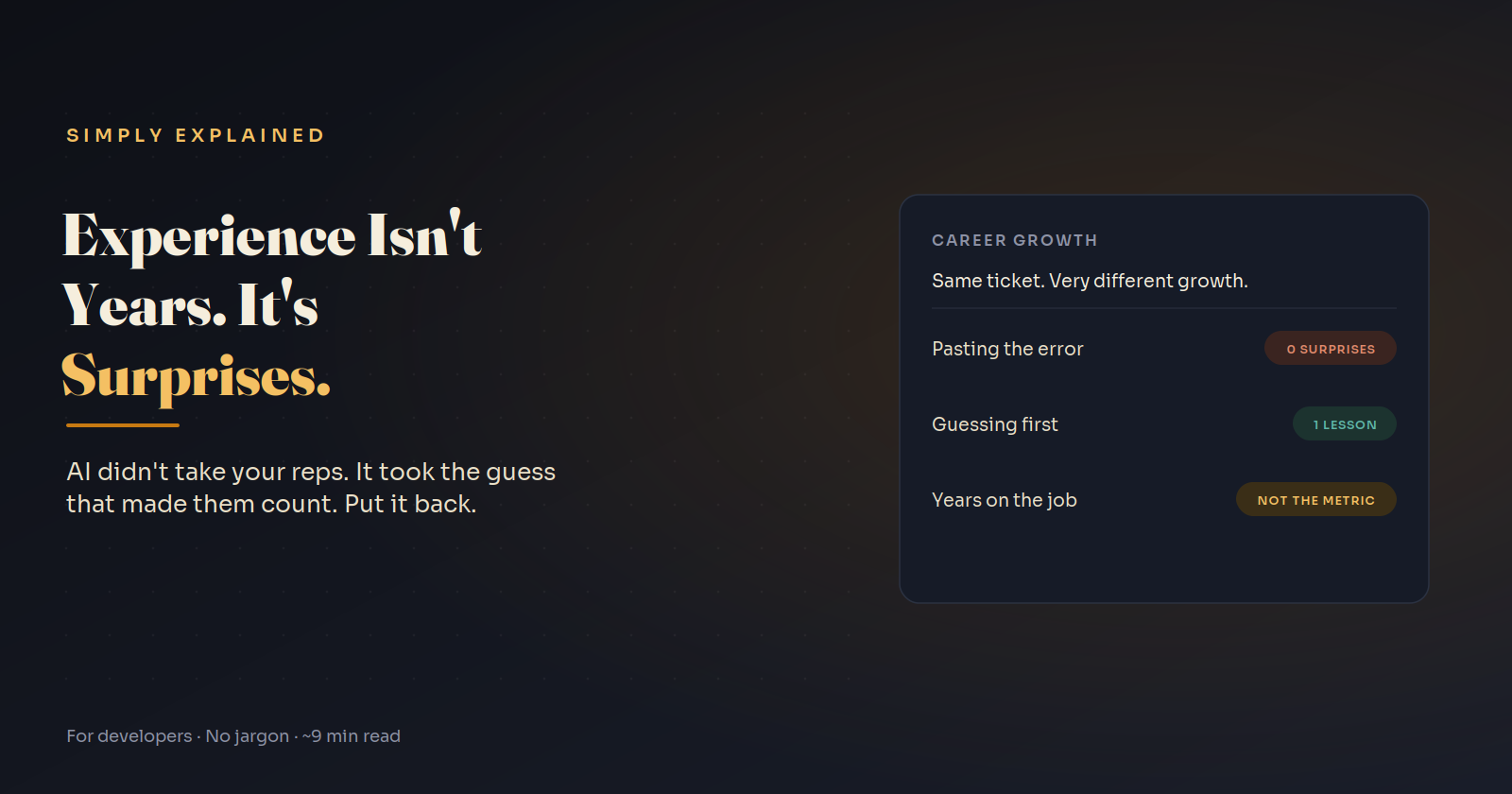
Your career metric was never lines shipped. It's corrections per week — and for the first time, that number is under your control.
Key Takeaways
Expertise is built from corrected predictions, not hours logged or code shipped.
The old grind wasn't valuable in itself; it was a slow, expensive delivery system for corrections.
Prompt-first work produces zero corrections because no belief was ever formed to be wrong.
Predict shape, break, and tradeoff in three lines before prompting, then diff the model's answer against your guess.
Log only the surprises. Ten entries will reveal an uncomfortably specific blind spot.
The honest cost: about 90 seconds per task, and it does not fix the hiring market.
What it costs
It's slower — roughly ninety seconds a task, plus the friction of committing to a guess you suspect is wrong. It also feels bad on purpose, and that discomfort is the signal.
The learning research here is old and consistent: people who guess before being told outperform people who are simply told, even when nearly every guess is wrong. Researchers call it errorful generation. In programming specifically, predicting what a snippet will output beats being walked through it.
What this does not fix is the hiring market. Predicting before you prompt will not conjure open junior roles. It fixes a different problem: whether the next two years produce someone worth hiring, or someone with two years of experience and no model of anything.
The genuinely good news
The doom version of this story ends with juniors locked out of expertise. That isn't right either.
The old apprenticeship trickled corrections to you, gated by luck and someone else's calendar. The new setup can hand you a correction on every task, on demand, at any depth, from something that never gets impatient and never sighs when you ask why. You can ask it to attack your prediction. You can ask what a staff engineer would worry about that you missed. You can be wrong twenty times before lunch at no social cost.
No junior in 2015 had anything close to that.
AI didn't take your reps away. It made them optional — and almost everyone is choosing to skip them.
FAQ
Is AI really replacing junior developers?
Junior hiring has contracted sharply and the bar for entry has risen, but the more useful framing is that AI absorbed the tasks juniors used to learn on. The job didn't vanish; the built-in training loop did. That loop can be rebuilt deliberately by any individual junior, which is the part the hiring debate never gets to.
How do junior developers learn faster with AI?
By making a prediction before every prompt. Write down what you expect the answer to look like, where it will break, and what tradeoff you're accepting. Then diff the model's answer against your guess. The gap between the two is the lesson, and it takes about 90 seconds per task.
What does "predict before you prompt" mean?
It means forming an explicit, written belief about a task before asking AI to solve it, so the model's output can correct you instead of simply informing you. Reading a correct answer teaches almost nothing. Discovering that your specific guess was wrong in a specific way teaches a great deal.
Why do I ship more code but feel like I'm not improving?
Because output was never what made you better. Corrected predictions were. Prompt-first work produces plenty of output and zero corrections, so high productivity and flat skill growth can coexist. It's an accurate self-assessment, not imposter syndrome.
Should I stop using AI to learn programming properly?
No. Avoiding AI is slower and doesn't scale to how teams actually work now. Change the order, not the tool: guess first, then ask. You keep the speed and recover the learning that prompt-first work quietly deletes.
What skills matter most for junior developers now?
Judgment and verification — the ability to say why an approach is right and where it will fail. Both are downstream of prediction. You cannot verify an answer you had no expectation about; you can only agree with it, which is what most AI code review currently is.
Related reading
AI Won't Take Your Coding Job. It Will Change It. — why verification became the job
AI Writes Code That Looks Right — why reviewing AI output is harder than it feels
How to Let AI Think for You Without It Thinking for You — where offloading helps and where it costs you
You're Using AI Like a Search Bar — the collaborator mindset
The Basics of AI: A Beginner’s Guide to How Artificial Intelligence Actually Works — Basics of AI
Start Here — the full Simply Explained map
The bottom line
Don't overhaul your workflow. Take one real task tomorrow, write three lines before you prompt, then diff. Keep a file with one line per surprise — not what you learned, what surprised you.
The people who come out of the next three years dangerous won't be the ones who prompted best. They'll be the ones who kept making predictions when nothing forced them to.
Adam Jaber writes Simply Explained — complex topics, made simple. No jargon, no hype.