Why You Stopped Learning at Work (And Barely Noticed)
Engineering experience is measured in corrections, not years — and AI quietly removed most of yours.
Two engineers joined the same team eighteen months ago. Same stack, same standup, same AI tools. Their Git histories are nearly indistinguishable — similar merged pull requests, similar throughput, similar review turnaround.
Then production fell over at 2am. One of them looked at the dashboards, said "this smells like connection exhaustion, not the database," and was right within four minutes. The other could read every line of the same code and had no idea where to begin.
The difference isn't talent, and it isn't how much AI they used. One of them had been wrong, out loud, about a thousand times, and had found out each time. The other had been quietly correct all year — which turns out to be one of the least educational things that can happen to an engineer.
Experience is a surprise counter, not a clock
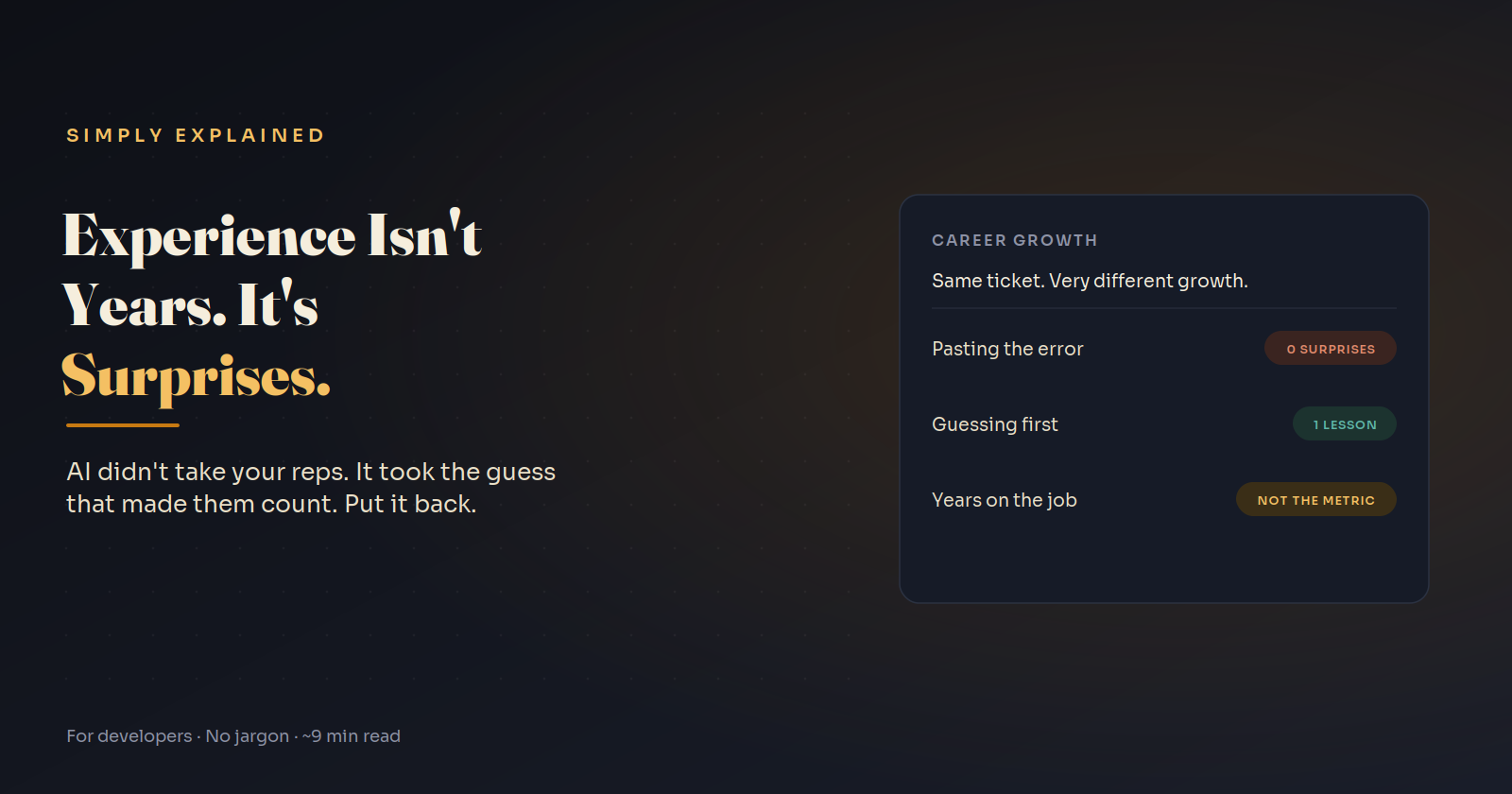
We measure experience in years because years are easy to count. But time doesn't update your model of a system. One specific event does: you expected X, you got Y, and you had to explain the gap.
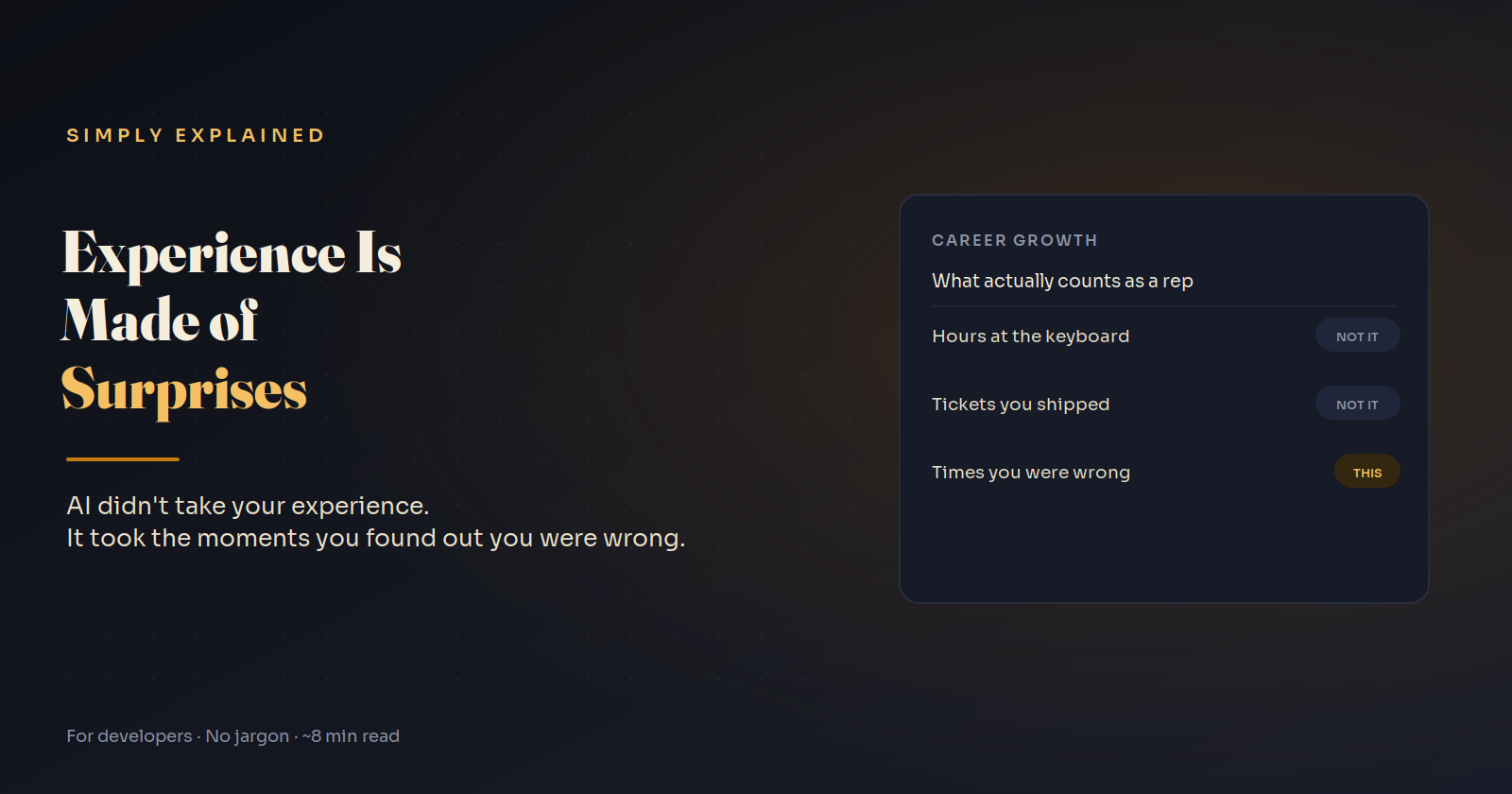
Every hunch you have — every "I've seen this before" that saves an afternoon — was installed by one of those collisions. So experience has a real unit, and it isn't the year. It's the corrected prediction.
A developer with three years and four hundred corrections is a different animal from one with three years and forty. No résumé format can tell them apart.
The grunt work was never the curriculum
The popular story right now: AI ate the boilerplate, the boilerplate was the apprenticeship, so juniors can't become seniors anymore. Junior hiring has visibly contracted and the story fits the mood.
It's half right, and the wrong half is the important one.
Writing your four-hundredth CRUD endpoint by hand taught nobody anything. What made that work valuable was underneath it: constant, cheap, low-stakes wrongness with a fast answer attached. You thought the query would be fine. It wasn't. You thought the null case couldn't happen. It did.
The boilerplate was never the curriculum. The feedback was. The tickets were just the delivery mechanism.
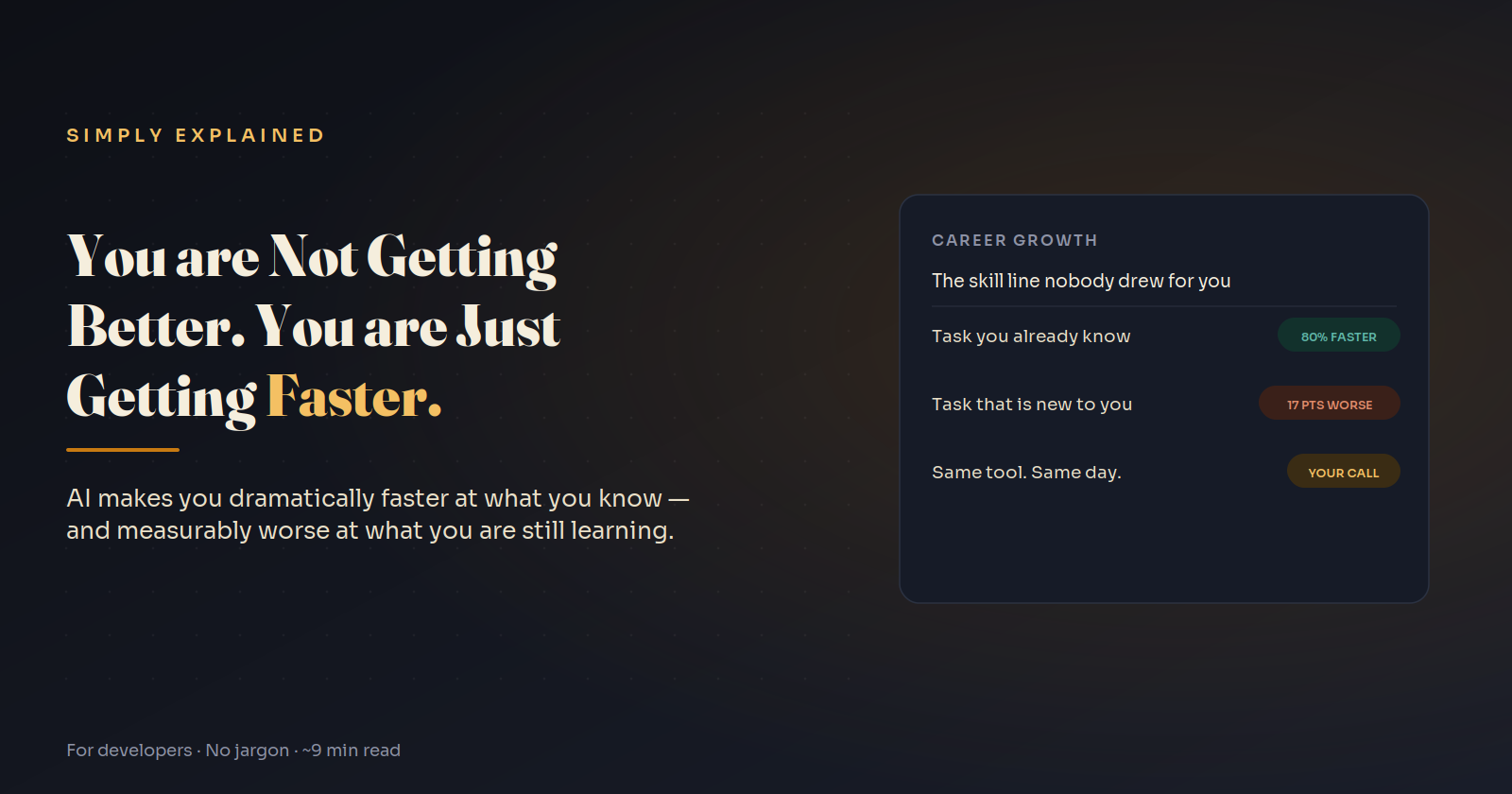
The real problem is narrower and worse: AI removed the gap between wanting something and having it work, and that gap was where the learning lived. You now get working code without ever going on the record about what you expected. No prediction, no collision. No collision, no update.
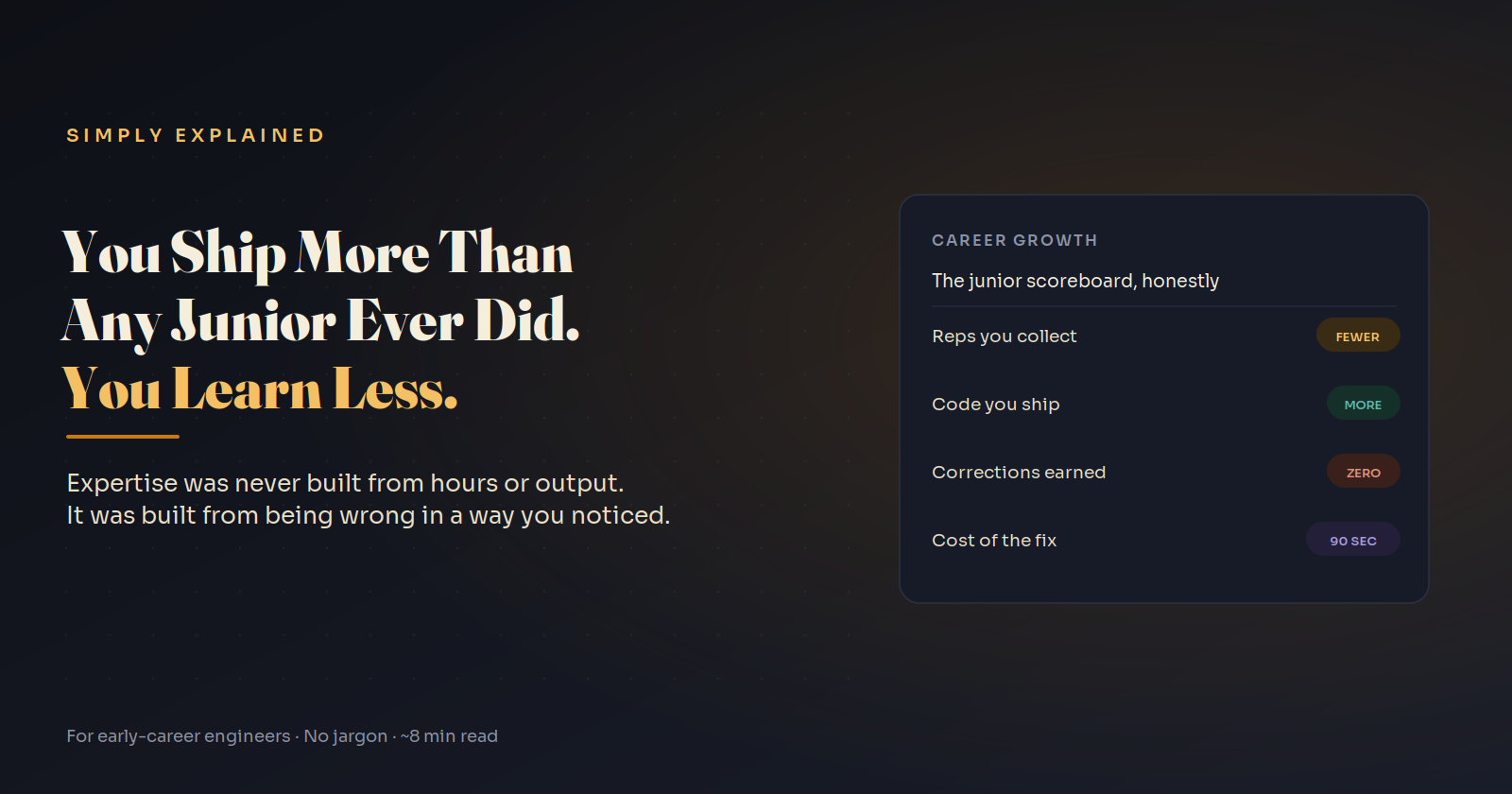
Today's junior produces more output than any junior in history while collecting fewer corrections than any junior in history. Only one of those shows up in the sprint report.
Why "just use AI less" doesn't fix it
The standard prescription is abstinence — no-AI Fridays, hand-write the hard parts, rebuild the muscle.
It's aimed at the wrong target. Difficulty was never the active ingredient. You can hand-write code for a year in a repo nobody reviews and learn almost nothing, slowly. Struggle without feedback is a longer commute to the same place.
And the reverse is the part nobody says: AI is the most efficient surprise generator ever attached to a keyboard. It will hand you a plausible answer to anything in seconds. That's either a machine that deletes your reps or one that multiplies them, and what decides it is small.
It's the order of operations.
Get on the record before you generate
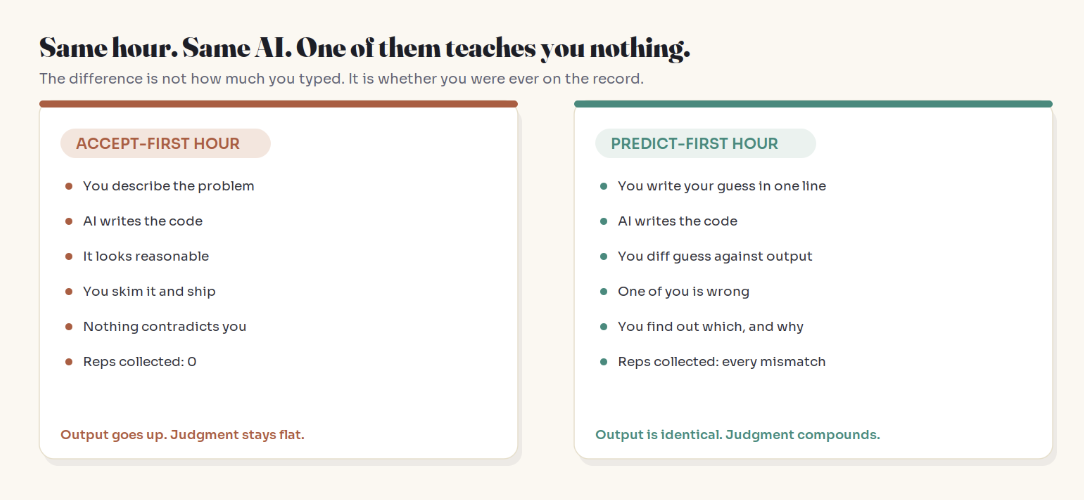
Before you accept the output — ideally before you send the prompt — write your expectation down. One line, ten seconds, in a comment you'll delete:
"This needs a transaction around both writes or the balance drifts."
"I think this breaks on empty input."
"I'd use a hash map here; I bet it writes nested loops."
"The slow part is the N+1, not the index."
Then generate. Then diff your line against what came back. When they disagree, find out which of you is wrong before moving on. Sometimes it's the model. Increasingly often it's you — and that's the good outcome. That's the rep.
You cannot be corrected if you never committed to an answer.
Ten seconds. It costs nothing in velocity, which matters, because any practice that makes you slower than your teammates gets abandoned by the second sprint.
Four ways to be wrong — yours cluster somewhere
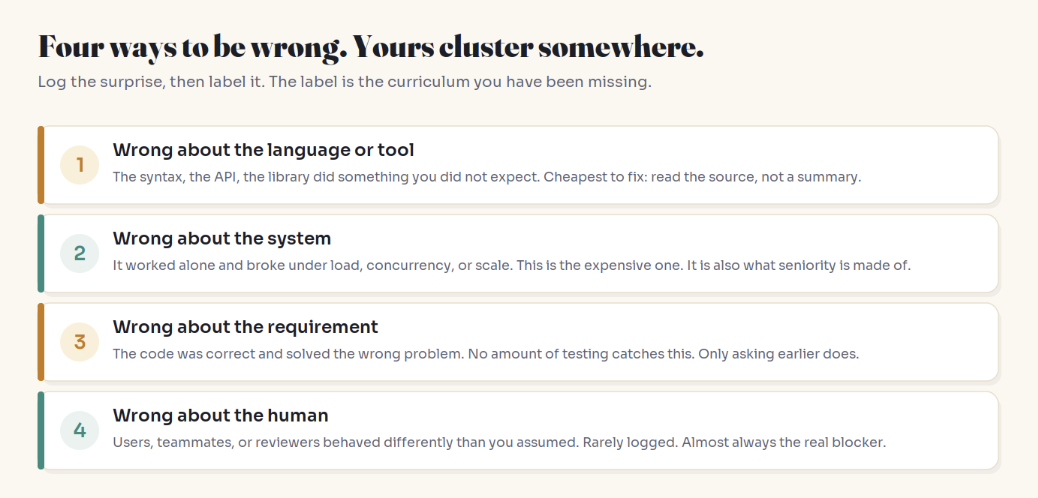
Once you log the moments you were wrong, they sort themselves into four buckets, and the distribution is a diagnosis.
Most developers find nearly everything in bucket one: syntax, APIs, library behavior. It feels like learning because it's uncomfortable. It's also the bucket AI is best at eliminating and the one that matters least at 2am.
The engineer who diagnosed the outage had a fat bucket two. She had watched things that worked perfectly in isolation die under concurrency, repeatedly, and had to explain why each time. You can't prompt your way to that.
Bucket three is the quiet career-limiter: perfectly correct code, wrong problem. AI made it more dangerous, because it builds whatever you describe, immediately, with total confidence — including the wrong thing.
The line nobody tracks
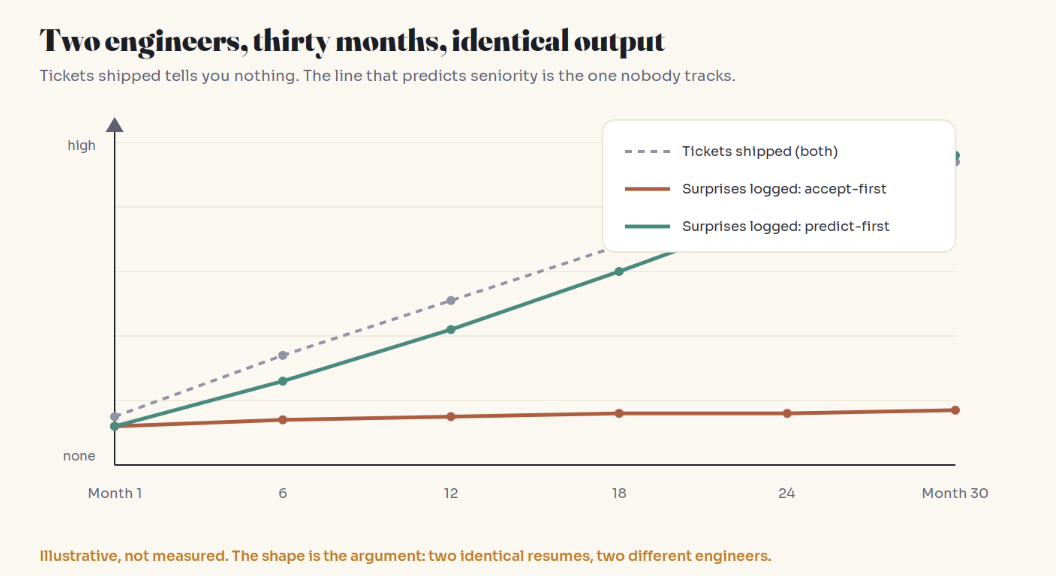
That shape is the argument, not a measurement. Two engineers, thirty months, near-identical output the whole way, separated by the one line that never appears in a performance review or a hiring dashboard.
It's also why the current industry panic is slightly misaimed. Everyone asks where the next generation of seniors comes from. Nobody asks what happens to the current ones, who are now shipping accept-first like everybody else.
Seniority isn't vested. It decays like any other skill you stop practicing.
Fifteen years of scar tissue buys a long runway, not a permanent one. If nothing has surprised you in six months, you aren't coasting on experience — you're spending it.
What this looks like in an actual week
Keep a surprise log. Five lines a week: what I expected, what happened, which bucket. Nobody rereads these. The point is that writing it forces you to have had a prediction. A week with zero entries taught you nothing, and now you know in time to fix it.
Review before you read. When AI hands you code, guess where the bug is before you look. "If this is broken, it's in the error handling." Then check. Being wrong about where a bug lives is one of the highest-density corrections available, and it takes fifteen seconds.
Chase bucket two deliberately. Your normal workload won't hand you concurrency failures anymore. Go find them: fifty simultaneous requests, kill the database mid-write, drop the timeout to 100ms and watch what happens downstream. Predict first, then break it. Failures you cause on a Tuesday are the ones you won't meet for the first time at 2am.
Key Takeaways
Engineering experience is measured in corrected predictions, not years or tickets shipped.
AI didn't remove the learning by removing the boilerplate — it removed the moment where you found out you were wrong.
Abstinence ("use AI less") targets difficulty, but difficulty was never the active ingredient; feedback was.
The fix is order of operations: write your expectation in one line before you generate, then diff it against the output.
Sort your surprises into four buckets — tool, system, requirement, human. Where they cluster is what you don't know.
Seniority decays. Experienced engineers shipping accept-first are losing judgment too, just from a higher starting point.
FAQ
What is AI skill atrophy in software engineering?
It's the gradual loss of engineering judgment that happens when AI produces working code before you form any expectation about it. The mechanism isn't using AI too much — it's never being corrected, because you never committed to a prediction the output could contradict.
How do developers gain real experience in the AI era?
By deliberately generating corrections instead of waiting for them. Write down what you expect before you prompt or accept, compare it to the result, and resolve the difference. Each mismatch you explain is a rep the old apprenticeship used to supply by accident.
Does using AI make you a worse programmer?
Not by itself. Accepting output without a prior expectation does. The same tool, used predict-first, generates more feedback per hour than any traditional junior workload ever did.
Should junior developers avoid AI coding tools to learn faster?
No. Avoiding AI restores difficulty, not feedback, and you can struggle for a year without learning much. A better rule is to never accept generated code you didn't first make a guess about.
Is the junior developer pipeline really broken?
The entry-level path has narrowed and the traditional apprenticeship has thinned out. But the mechanism people blame — losing the boilerplate — is the wrong one. Losing the correction loop is the actual damage, and that part is individually recoverable.
Are senior engineers affected by AI skill atrophy too?
Yes, and often more quietly. Deep experience masks decay for a long time, so a senior reviewing AI output on autopilot can look highly effective for years while their edge erodes.
Related reading
AI Won't Take Your Coding Job. It Will Change It. — the argument this piece is the how-to sequel to.
AI Writes Code That Looks Right — the exact failure mode predict-first is designed to catch.
How to Let AI Think for You Without It Thinking for You — offloading versus surrender.
Your Database Is Fine. Your App Is Dying Anyway. — a bucket-two classic: healthy in isolation, dying under load.
Start Here — the full Simply Explained map.
The bottom line
The old apprenticeship was slow, accidental and wildly inefficient. You waited years for the right bug to find you. Now there's a machine in your editor that can put a plausible answer in front of you every ninety seconds — which means it can put you on the record every ninety seconds, if you let it.
AI can delete your surprises or multiply them. Nothing decides which except whether you guess first.
Adam Jaber writes Simply Explained — complex topics, made simple. No jargon, no hype.