Junior Developers and AI: Your Errors Were the Training All Along
The junior job quietly paid for your mistakes. AI removes them. Here's how to learn to code with AI without stalling your growth.
A junior developer spends an afternoon on a bug where orders show up dated a day late. By 4:30 she's found it: UTC in the database, local time on the page. She never forgets it.
Another junior pastes the same error into an AI assistant. Forty seconds, a correct fix, tests green, next ticket.
He had the better afternoon. This post is about who has the better career, and about the thing AI quietly removed from the junior developer job without anyone deciding to remove it.
Key Takeaways
The junior developer role was an apprenticeship disguised as a job: companies absorbed your mistakes because those mistakes turned you into a mid-level engineer.
AI makes junior-level code cheap, so what shrinks isn't coding work. It's the budget for your mistakes.
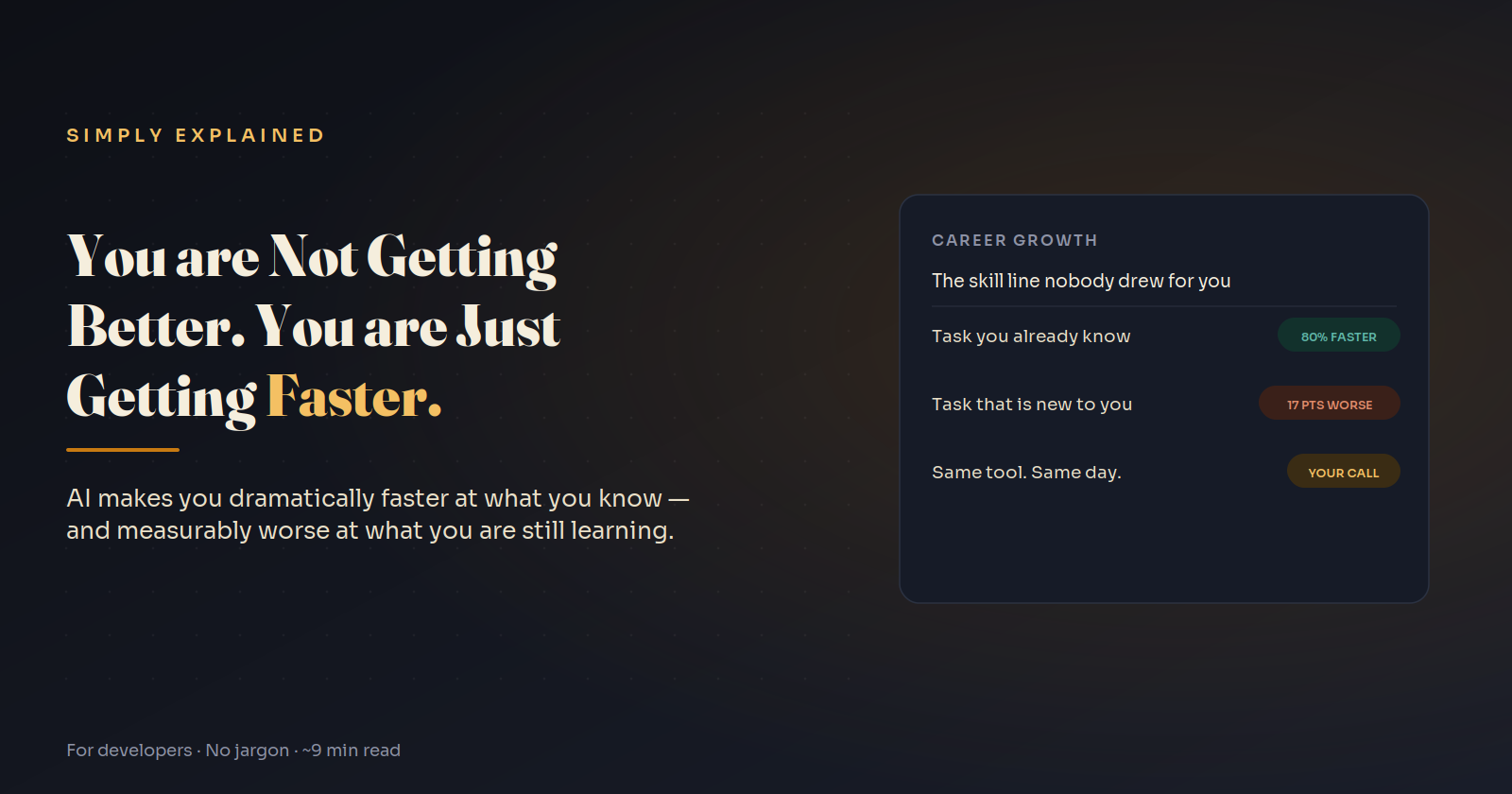
In a 2026 Anthropic randomized trial, developers learning a new library with AI scored 50% on a follow-up quiz versus 67% for hand-coders, with the widest gap on debugging.
The fastest pattern (full delegation) hit few or no errors and scored lowest. A conceptual-questions-only pattern hit many errors, fixed them, scored 65%+, and was second fastest.
Seniority is a ledger: a shipped column AI can fill, and an understood column only your own debugging can fill.
Run your own apprenticeship: guess first, struggle on a timer, ask for concepts, never merge what you can't explain, keep a failure ledger.
The deal behind the junior developer job
The offer letter said: salary in, code out. The real deal was different. You were paid to be slow, wrong, and occasionally destructive in places where that was survivable. Most of your year-one code was a byproduct a senior could have written faster. The product was you.
AI makes the byproduct nearly free. So when a company trims junior hiring, it isn't cutting "coding". It's cutting the budget for your mistakes, and that budget was the training.
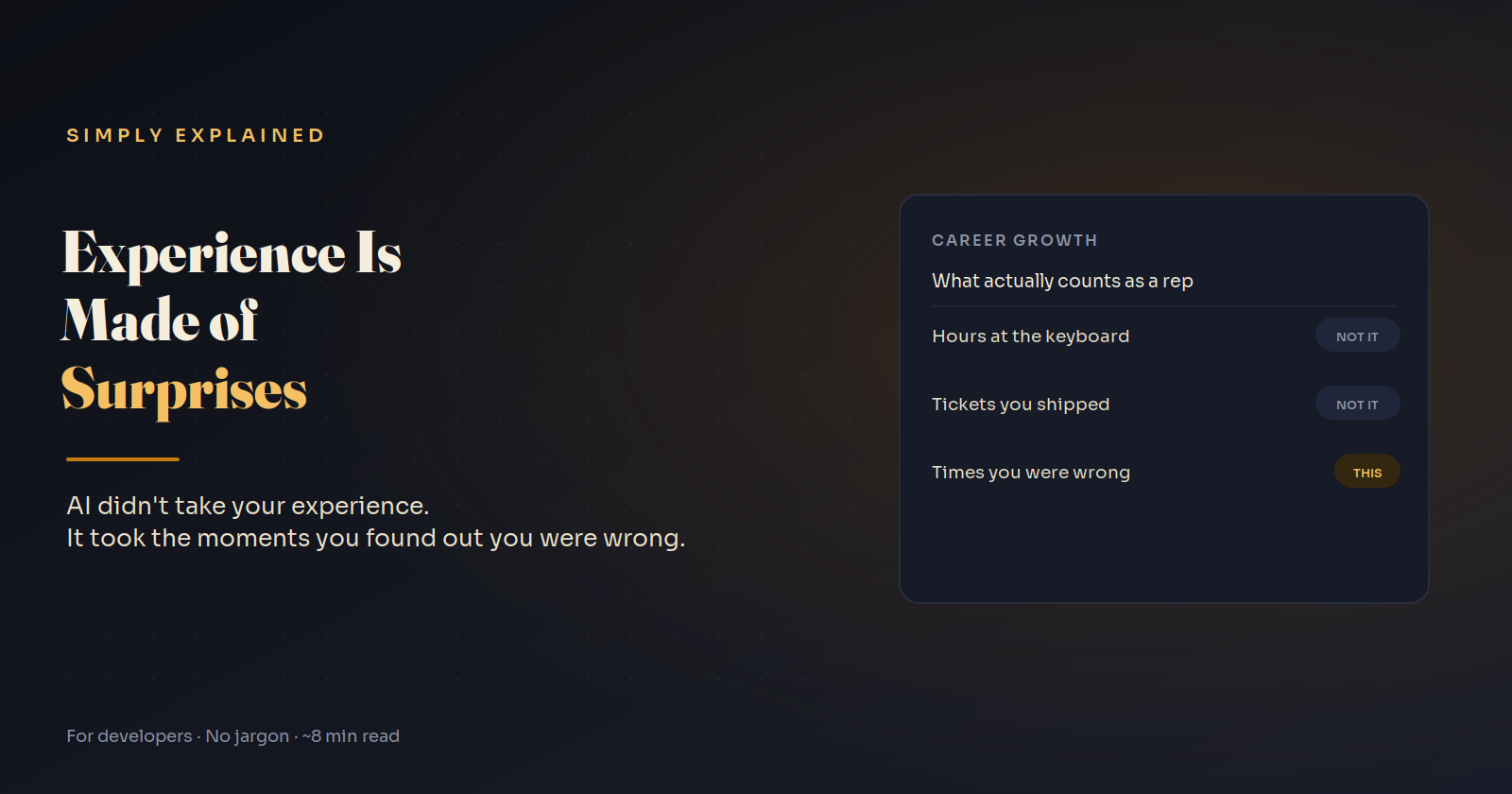
Your first dev job was never paying you for your code. It was paying for your mistakes.
What the 2026 AI skill-formation study found
Anthropic researchers ran a randomized controlled trial with 52 mostly junior engineers who used Python weekly but had never used Trio, an async library. They built two features with it, half with an AI assistant that could see their code and write the answer on request, half with docs and search. Then everyone took a quiz without AI.
Speed: the AI group was about two minutes faster on average, not statistically significant.
Mastery: 50% average quiz score with AI versus 67% by hand.
Biggest gap: debugging, the skill you need to catch an AI's mistakes.
The screen recordings are where it gets useful:
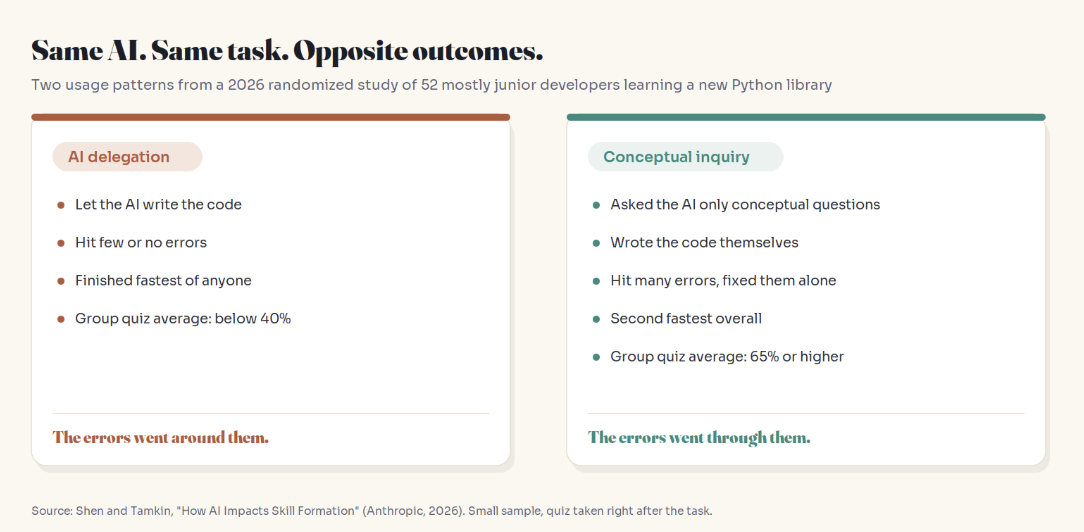
The delegators finished fastest and hit few or no errors. Their group averaged below 40%. The conceptual-inquiry group asked only "why" questions, wrote their own code, hit many errors, resolved them alone, averaged 65%+, and still came second on speed. The researchers' hypothesis for the hand-coders' edge: they met more errors tied to the tested concepts and got better at debugging by fixing them independently.
Caveats, as the authors note: small sample, quiz taken immediately, long-term effects unknown.
The fastest people in the study hit almost no errors. They also learned the least.
Seniority is a ledger with two columns
Left column: what you've shipped. Right column: what you understand, like why a webhook charged twice on a retry, or why two workers overwrote the same row.
A bug only writes to the right column if it passes through you. Paste it away and the feature still ships, but your right column stays blank.
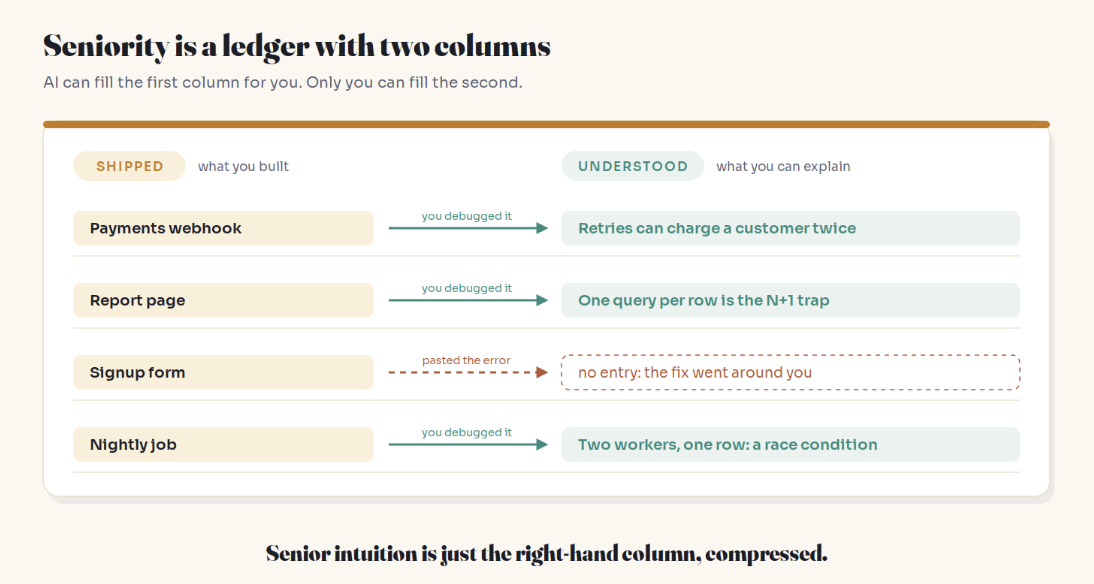
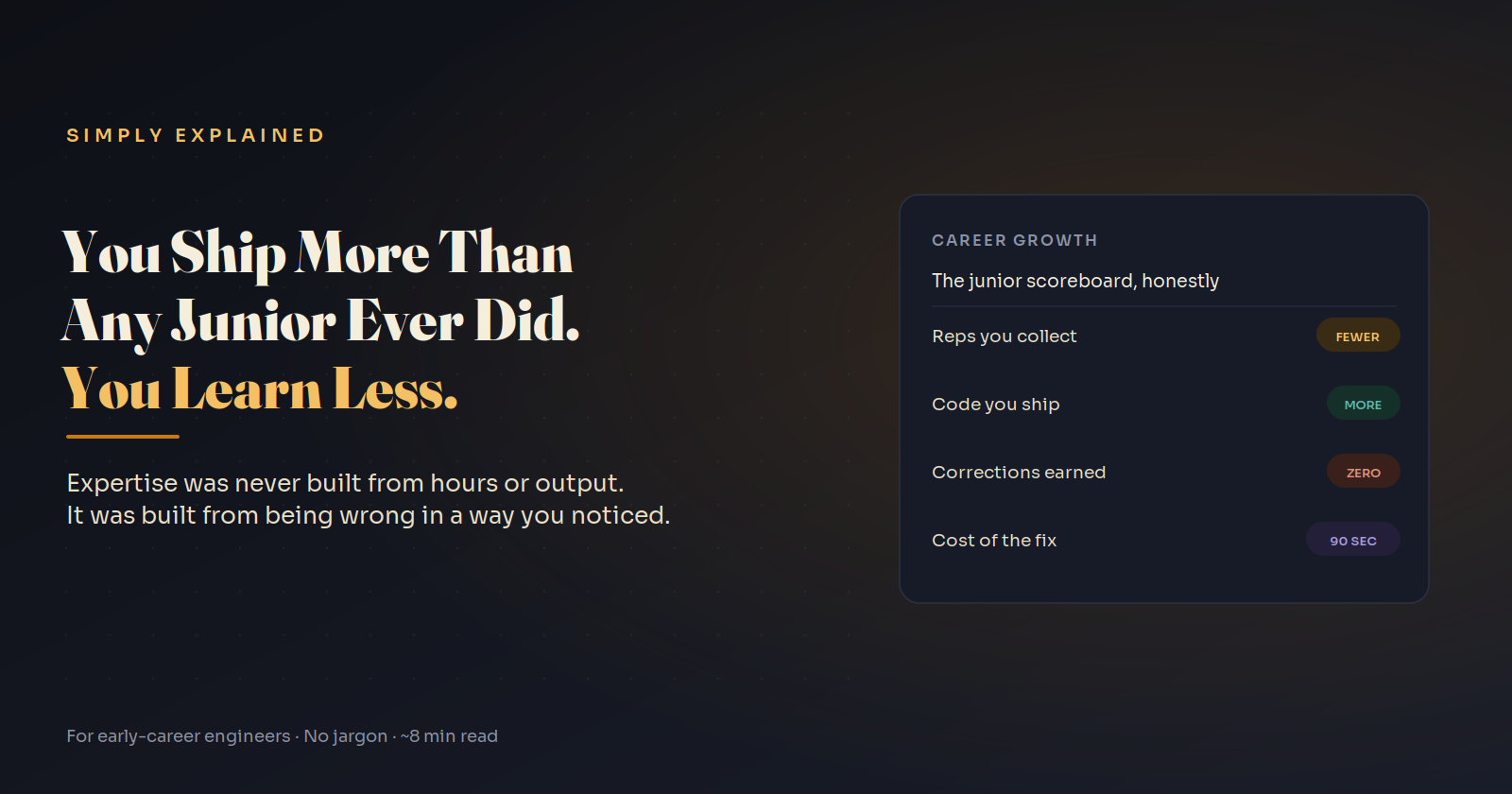
AI fills the left column brilliantly. It can't touch the right one. That's what "senior intuition" really is: hundreds of right-column entries compressed into a reflex.
Senior intuition is just failure, compressed.
Interviews, incidents, and promotions read the right column. And the market now wants juniors to arrive with entries the job used to hand out, so you have to earn them on purpose.
How to learn to code with AI without skipping the learning
The high-scoring groups all used AI. They used it so errors flowed through them.
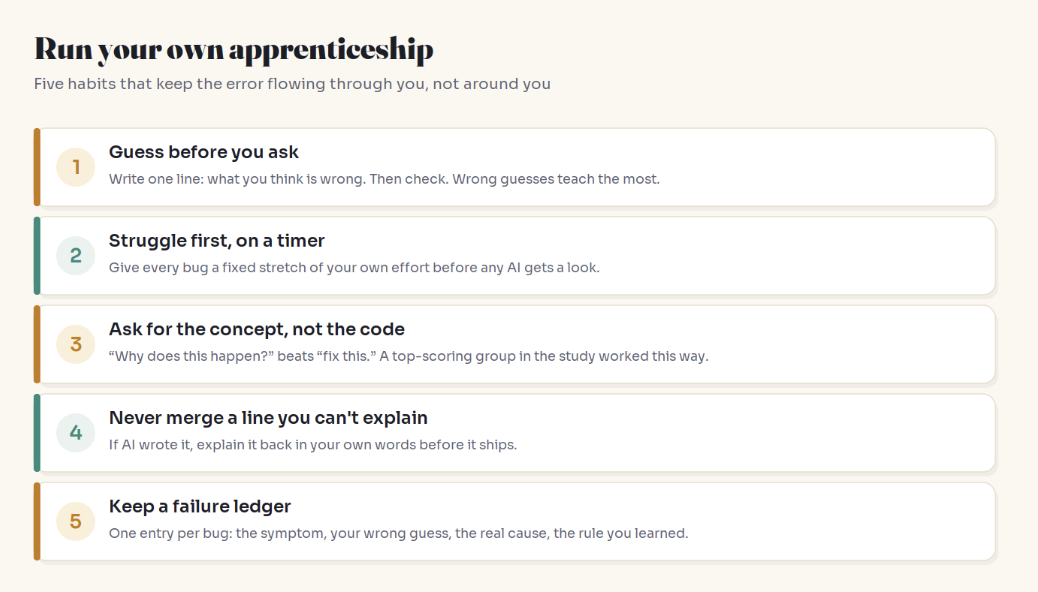
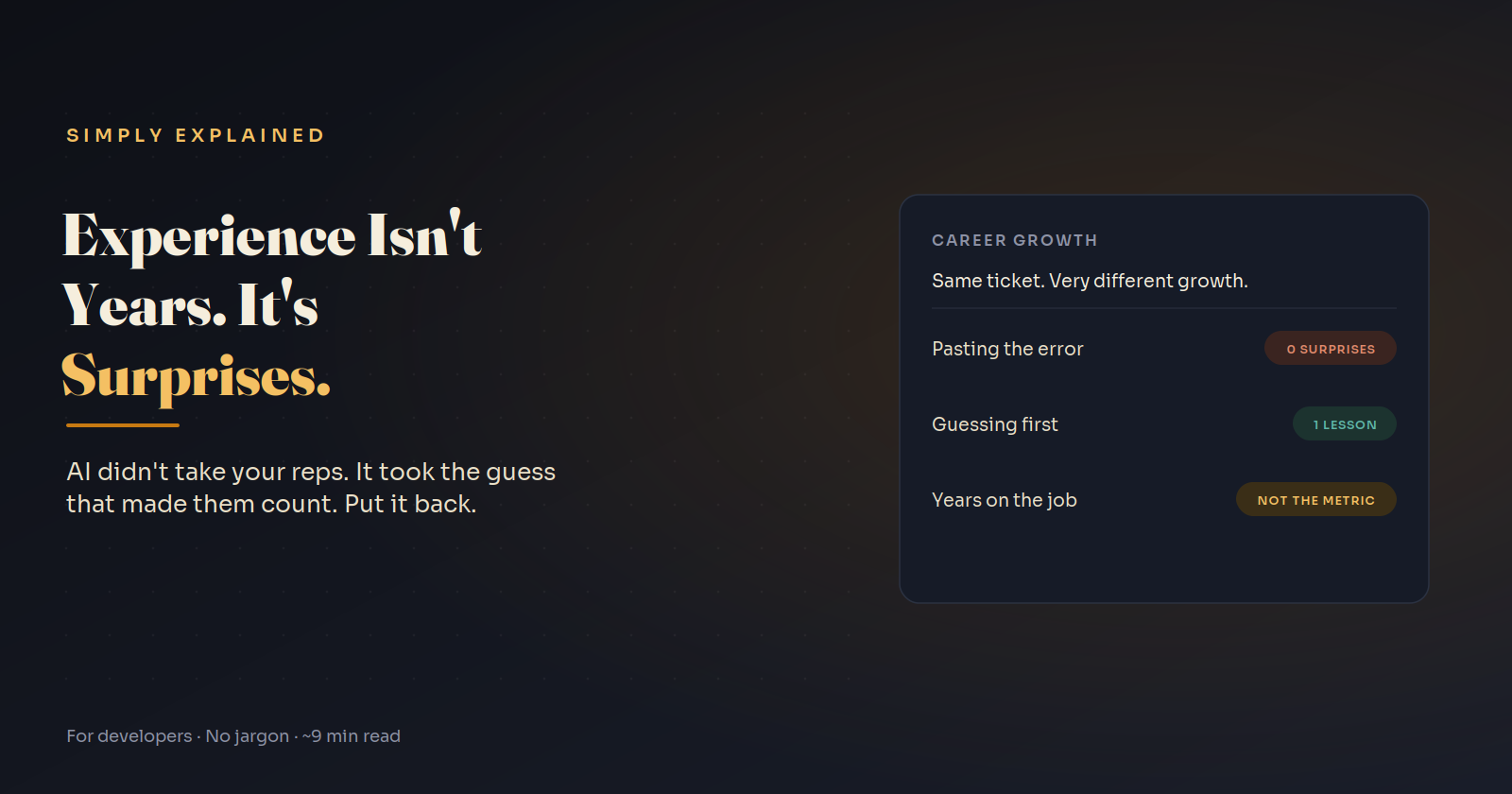
Guess before you ask. One sentence on what you think is wrong, then check. Wrong guesses teach the most.
Struggle first, on a timer. A fixed window of your own effort, often 20–30 minutes, before AI sees the bug.
Ask for the concept, not the code. "Why would two async tasks see the old value?" beats "fix this."
Never merge a line you can't explain. Another high-scoring group generated code, then asked follow-ups until they understood it.
Keep a failure ledger. Symptom, wrong guess, real cause, the rule you learned. Three minutes per bug.
Your portfolio: show what broke
A list of features can't prove who wrote them anymore. A failure story can, because it survives ten minutes of follow-up questions. Build something small that real users touch, with a scheduled job, a webhook, and a growing table, then document what broke and why. Concurrency and load bugs make the best entries.
A feature list proves AI can code. A failure log proves you can.
For mentors: when a junior brings you a bug, hand it back with a question ("what did you expect this line to do?") before you hand back a fix.
FAQ
Is AI bad for junior developers learning to code?
Not inherently. In the 2026 Anthropic study, every high-scoring usage pattern involved AI. What hurt learning was full delegation, where the AI wrote the code and the developer rarely met an error.
Why do junior developers need to make mistakes?
Because debugging your own mistakes is how the understanding that makes someone senior gets built. The study's researchers linked the hand-coding group's advantage to encountering and resolving errors themselves.
How long should I try to fix a bug before asking AI?
There's no proven number. A fixed window you can sustain, often 20–30 minutes, works because it stops frustration from making the decision and keeps the first stretch of confusion, which is where much of the learning happens.
What is the best way to use AI when learning programming?
Ask conceptual questions and write the code yourself, or generate code and then ask follow-up questions until you can explain every line. Both patterns scored well in the study.
What should a junior developer portfolio include in 2026?
Working, deployed software plus written accounts of real failures: the symptom, your wrong guess, the root cause, and the fix. Failure stories are hard to fake and survive interview follow-ups.
Are junior developer jobs disappearing because of AI?
Hiring expectations have risen: many roles titled "junior" now expect skills that used to be learned on the job. The work that trained juniors is being automated, so the training increasingly has to be arranged deliberately.
Related reading
AI Won't Take Your Coding Job. It Will Change It. — the job is shifting toward verification and judgment
How to Let AI Think for You Without It Thinking for You — the same habits outside of code
Your Database Transaction Didn't Save You From This Bug — a classic right-column entry
Your Database Is Fine. Your App Is Dying Anyway. — another one that only shows up under load
The bottom line
Nobody is going to pay for your debugging afternoons the way companies used to. That doesn't make them less valuable. It makes them yours to arrange.
AI can make you productive on day one. Only your mistakes can make you senior.
Adam Jaber is a software engineer who writes Simply Explained: complex topics, made simple. No jargon, no hype.