
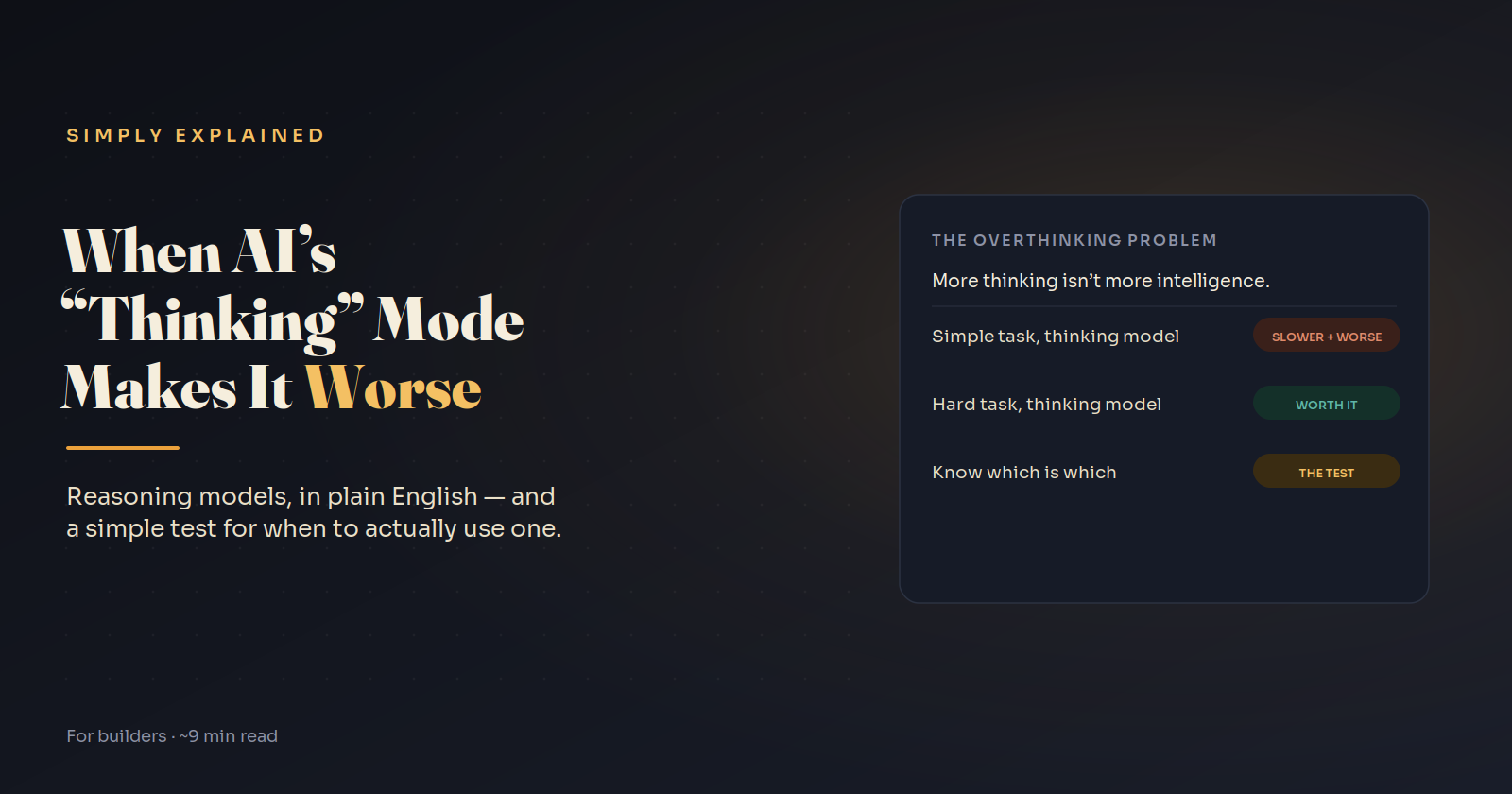
When AI's 'Thinking' Mode Actually Makes It Worse
Reasoning models are a genuine leap — on the right problems. On the wrong ones, thinking longer makes AI slower, pricier, and less accurate. Here's the test.
Aug 21, 202610 min read
Search for a command to run...
Series
Plain-English deep dives into how AI actually works under the hood — and how to build with it without the hype. Prompting that gets real results, how RAG systems retrieve before they answer, working with coding agents, and the compounding-error math behind why autonomous agents fail in production. For developers and the technically curious who want the practical layer beneath the buzzwords. No jargon, no hype — just clear mental models you can use.
Reasoning models are a genuine leap — on the right problems. On the wrong ones, thinking longer makes AI slower, pricier, and less accurate. Here's the test.
AI-generated code fails differently than human code — it looks polished and confident while being subtly wrong. Here are the 5 failure modes and how to review for them.

A language model can only produce text — so how do AI agents check the weather, query databases, and book meetings? The answer is tool calling. Here's the whole mechanism.

A stranger can hide a sentence in a webpage or email and your AI will obey it. It's OWASP's #1 AI risk — and unlike SQL injection, it can't be cleanly fixed. Here's why, and how to contain it.
