How to Actually Work With AI Coding Agents (A Practical Guide for 2026)
Your AI tool stopped suggesting and started doing. Here's the workflow that actually works.

Your AI tool stopped suggesting and started doing. That changes your job more than anyone told you — here's the workflow that actually works.
Something changed in the last year, and most developers are still using the new thing with the old habits.
AI stopped being autocomplete. It stopped being a chat window you paste snippets into. Today's coding tools read your repository, make a plan, edit a dozen files, run your tests, and hand you a pull request.
Which means the skill you need isn't prompting anymore. It's delegating — and almost nobody was taught how to do that.
What actually changed
The shift has a name: supervised agency. Older tools completed the line you were typing. A 2026 agent takes a goal — "add pagination to this endpoint," "fix this failing test" — and executes a sequence of steps to get there: reading files, running permitted commands, drafting the fix, running the tests, and preparing a PR for your review.
This is now mainstream, not fringe. By mid-2026, roughly 85% of developers report using AI coding tools regularly. So the question isn't whether to use them. It's whether you're using them like a professional or like someone pulling a slot machine lever.
You're not writing code with an assistant anymore. You're managing a very fast, very confident junior developer.
Hold onto that analogy, because everything useful follows from it. A brilliant junior with no context, no plan, and no review will absolutely wreck your codebase — enthusiastically. The same junior, given a scoped task, the right files, an approved plan, and a code review, is genuinely valuable. Same person. Completely different outcome. That's your agent.
The loop that makes agents reliable
The single biggest difference between developers who get value from agents and those who rage-quit them is that the first group follows a loop. The pattern that keeps showing up in real teams' practices is Explore, Plan, Implement, Verify.
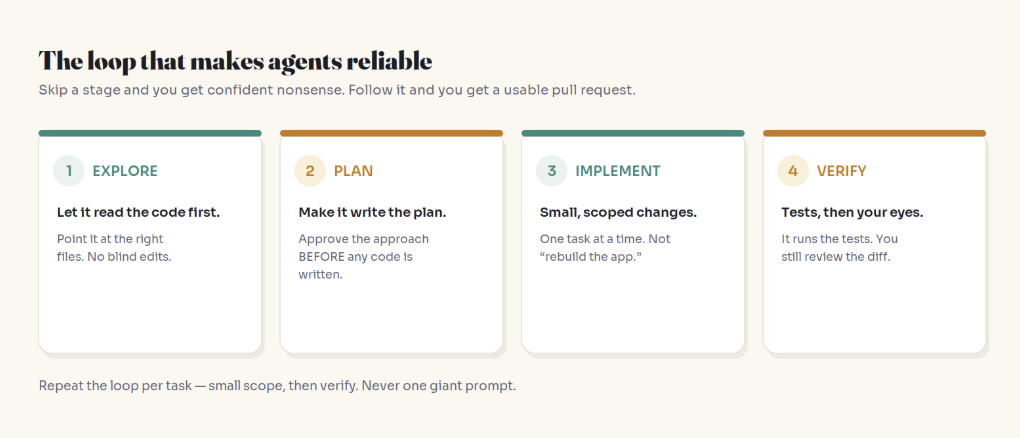
Explore. Before it writes a single line, make it read. Point it at the relevant files and ask what's there. Half of all agent disasters come from an agent confidently editing code it never looked at.
Plan. This is the step almost everyone skips, and it's the highest-leverage one. Make it tell you how it intends to solve the problem, then approve or correct the approach before any code exists. Fixing a bad plan costs one sentence. Fixing a bad implementation costs an afternoon.
Implement. One small, scoped task at a time. "Add pagination to this endpoint" works. "Rebuild the checkout flow" produces a 40-file diff nobody will ever review properly.
Verify. Let it run the tests — then read the diff yourself. Tests passing means it didn't break what you thought to check. It doesn't mean the code is good.
The plan-first prompt, if you want to steal it:
Before writing any code: read [these files], then explain what you found and how you plan to implement [task]. List the files you'll change and why. Don't write code until I approve the plan. Context is the whole game
Here's the thing every experienced agent user eventually learns: the model's raw intelligence is rarely your bottleneck. What it can see is.
An agent dropped into your repo is like a contractor who's never seen your house, doesn't know which walls are load-bearing, and has no idea why the previous owner did that weird thing with the plumbing. It will make reasonable-looking decisions that are wrong for reasons it had no way to know.
That's exactly why every serious study finds the same thing: agents perform dramatically worse on existing codebases than on greenfield projects. Generating new code is easy. Understanding code humans wrote — with its implicit conventions, undocumented assumptions, and accumulated history — is the hard part.
So your job is to close that gap:
Point at the right files rather than hoping it finds them. Keep a project instructions file (most tools support one) with your stack, conventions, and the things you always want it to do or never do. This pays off every single session. Say what "done" means — which tests must pass, what must not change. Give an example of a similar thing done right in your codebase. One reference file beats a paragraph of description.
Prompt engineering optimized one instruction. Context engineering curates everything the model can see. The second one matters more.
Delegate like a manager, not a gambler
Give the same agent the same task two different ways and you get two completely different results. This is the part that's actually a management skill.
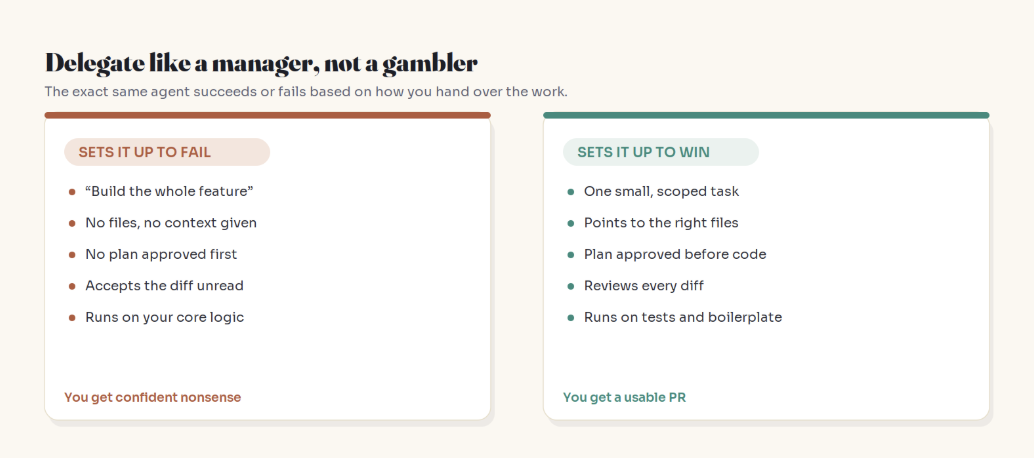
A good manager doesn't say "handle the backend" and disappear. They scope the task, share context, agree on the approach, set a checkpoint, and review the work. That's not bureaucracy — it's how you get usable output from someone who doesn't have your knowledge in their head.
Everything that feels tedious about working with agents is exactly the thing that makes them work.
What to hand over — and what to keep
Not every task is agent-shaped. The rule of thumb: the more your judgment matters, the less you delegate.
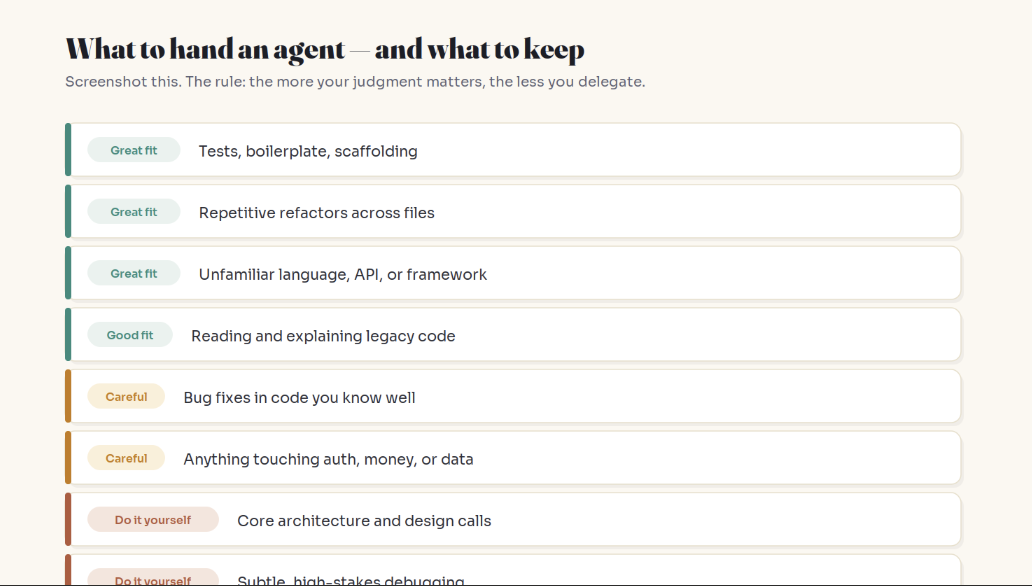
Agents shine on tests, boilerplate, scaffolding, repetitive multi-file refactors, and anything in a language or framework you don't know well. They're useful — with supervision — for reading and explaining unfamiliar legacy code, which is quietly one of the best uses nobody talks about.
Be careful with bug fixes in code you know deeply (you're often faster), and with anything touching authentication, payments, or user data. And keep the architecture, the design calls, and the subtle high-stakes debugging for yourself. Those are the parts where being wrong is expensive and where your experience is the entire value.
The review problem nobody warns you about
Here's the trap that catches good developers. An agent hands you 300 lines that look plausible, the tests pass, and you're busy. Reviewing it properly would take 30 minutes. Skimming it takes two.
You know which one happens on a Friday afternoon.
This is why agent output has a reputation for slipping bugs and security issues into codebases — not because the code is always bad, but because the volume outpaces the attention. The agent generates faster than any human can genuinely review, and something has to give.
The practical fix: keep the diff reviewable. Prefer many small agent tasks over one big one. If you're staring at a diff too large to read carefully, that's not a review problem — it's a scoping problem, and the fix happens upstream. A 40-file PR you skimmed is worse than a 4-file PR you actually understood.
And the rule that never changes: if it lands in your pull request, it's yours. Your name is on the commit. "The agent wrote it" has never once helped in an incident review.
How to start (without blowing up your codebase)
If you're new to this, don't begin by pointing an agent at production. Build trust the way you would with a new hire:
Week one: read-only. Ask it to explain parts of your codebase. Zero risk, and you'll immediately learn how good its context actually is. Week two: throwaway work. Tests, scripts, boilerplate, a side project. Things where a mistake costs nothing. Week three: small real tasks, plan-first and fully reviewed. One scoped change at a time. Then expand — deliberately. Give it more autonomy only where it's earned your trust, and keep it away from the crown jewels.
One more habit worth building early: notice when the loop is failing. If you've re-prompted four times and it's still not right, stop. That's the agent telling you the task is underspecified, the context is missing, or this is simply a job for you. Re-prompting on tilt is how people lose an hour and their afternoon.
Which agent should you use?
Deliberately, I'm not going to rank tools — the landscape shifts every few months, and whatever I name will be stale by the time you read this. What's more useful is knowing that developers' evaluation criteria have matured. The 2026 question is no longer "which agent is smartest?" but "which one won't hallucinate, and what does it cost to run?"
Judge candidates on three things instead of hype: how well it handles your real codebase (not a demo), how naturally it fits your existing workflow, and whether the cost makes sense for how you'd actually use it. Try two on the same real task for a week. The right answer is personal and it changes.
The job is changing — upward
It's worth naming what this all adds up to. If agents write more of the raw code, your value moves up the stack: deciding what to build, providing the context nobody else has, reviewing with real judgment, and owning the outcome. That's not a diminished job. Honestly, it's a more senior one — and it arrives whether or not you feel ready.
The developers who thrive won't be the ones who type fastest, or the ones who refused to touch any of this. They'll be the ones who learned to direct these tools well while keeping their own skills sharp enough to catch what the tools get wrong.
The agent can write the code. You're still the one who has to know whether it should exist.
Start small, stay in the loop
AI coding agents are genuinely useful and genuinely dangerous in the same way a power tool is: enormous leverage, zero judgment. The developers getting real value aren't the ones who trust them most. They're the ones who scope tightly, share context generously, approve the plan, and read every diff.
Pick one small, boring task this week — a test suite, a refactor, a script. Run the full loop: explore, plan, implement, verify. Notice where it shines and where it flails. That single experiment will teach you more than any tool comparison.
Save this for the next time an agent hands you a 300-line diff. And tell me in the comments: what's the best thing you've successfully delegated to an agent — and the worst? I'll go first: great at tests, disastrous at anything involving my auth logic.