You Can't Spot AI Fakes by Looking Anymore. Here's What Actually Works.
The old advice — count fingers, check teeth, spot bad lighting — no longer works and gives false confidence. Here's the source-checking method that catches fakes when your eyes can't.
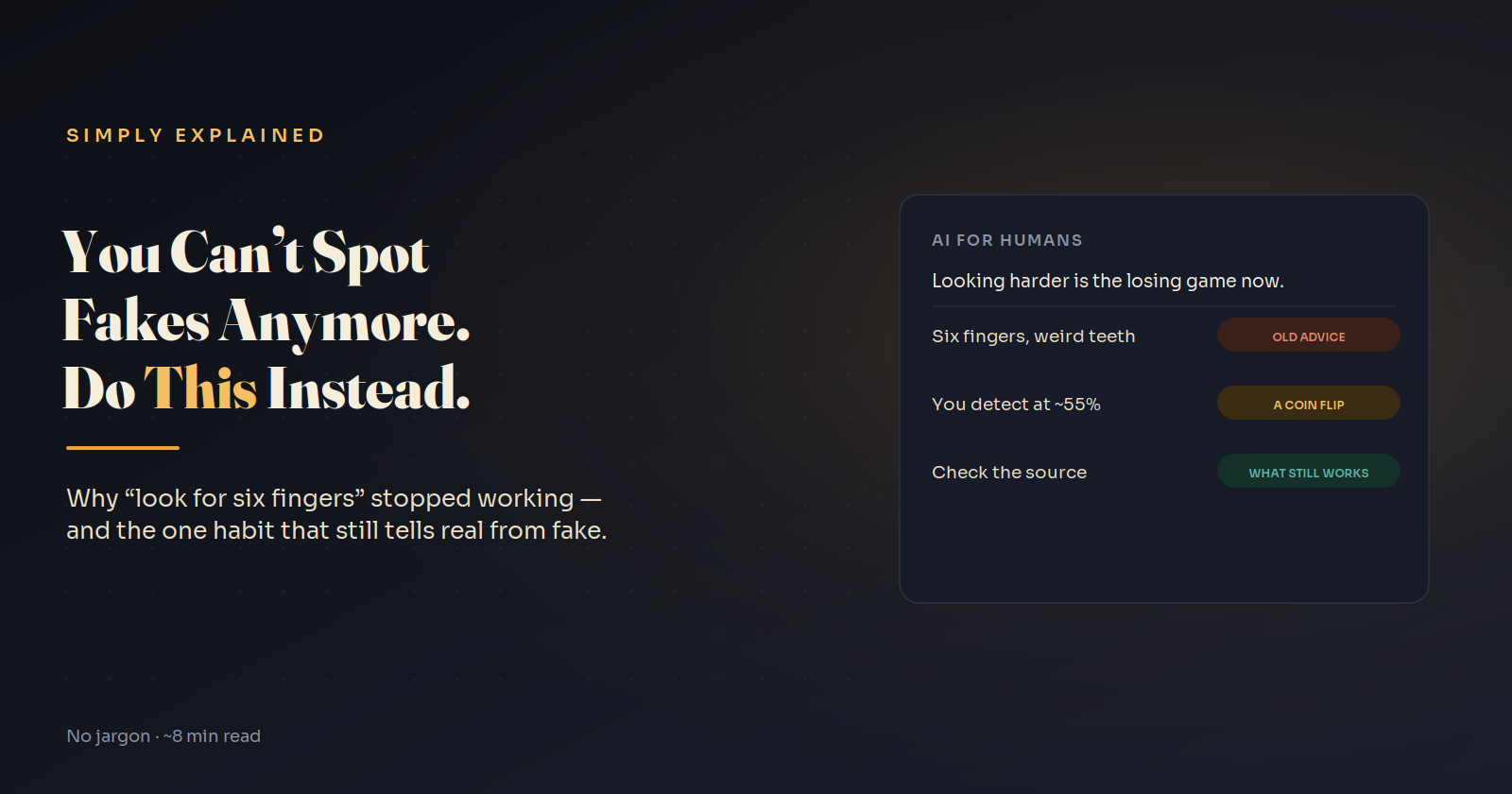
You've been taught to catch fakes by looking closer — count the fingers, check the teeth, spot the weird lighting. In 2026, that advice is not just useless, it's dangerous: it hands you false confidence right when you need real judgment. Here's the method that still works when your eyes can't.
A photo of a politician arrested in the street. A voice note from your boss asking you to move money, urgently. A heartfelt video from a celebrity. All three can be generated in under a minute, for free, by anyone — and they're good enough that "it looks real" no longer means anything.
For years we learned the same tricks: count the fingers, check the teeth, look for bad lighting. That advice worked right up until it quietly stopped being true. Modern AI nails all of it. The tells have been patched — which leaves most people armed with detection tricks that don't work, and therefore overconfident exactly when they can't afford to be.
Why your eyes are now a coin flip
When researchers test ordinary people on high-quality AI fakes, accuracy lands around 55% — barely better than guessing. Image generators now render realistic skin, reflections, correct anatomy, and consistent lighting.
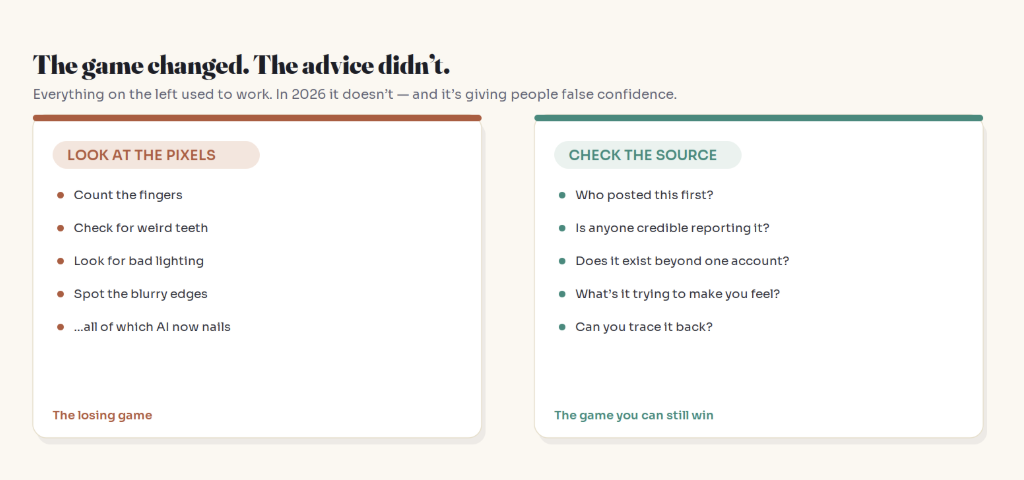
The trap in the old advice: "look for the flaws" made sense when fakes were crude. But every model improvement removes another tell, so the advice becomes a way to miss fakes with confidence. You check the hands, they look fine, you conclude "real." But modern fakes have fine hands.
The absence of a visible flaw used to mean "probably real." Now it means "not a lazy fake." Confusing those two is how smart people get fooled.
The shift: check the source, not the pixels
The question was never really "does this look real?" — that's the one you'll lose. The question that protects you is: "where did this come from, and can I trace it back?"
This works because of an asymmetry fakers can't fix. Making a convincing fake takes seconds. Giving it a real, traceable history — an original source, corroborating coverage, a chain of people who vouch for it — is something a fake fundamentally lacks. You can fake the pixels; you can't easily fake the provenance.
You can't out-see a machine that renders flawless pixels. But you can out-investigate a fake that has no past. Real things come from somewhere. Fakes usually come from nowhere.
The 30-second source check
You don't need to be a forensic analyst — just a short habit before you believe or share anything that matters: Stop, Find, Check, Trace.
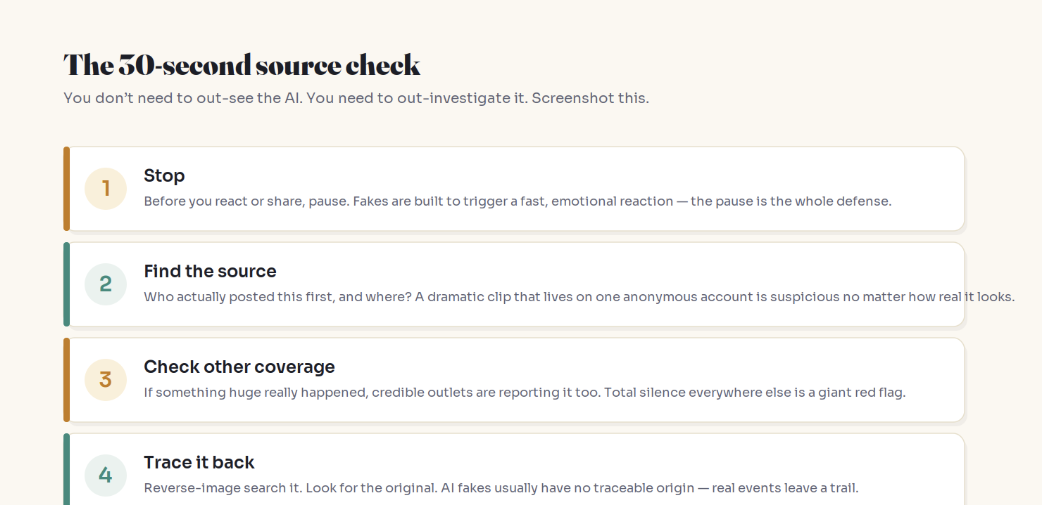
Stop. Before you react or share, pause. Fakes are engineered to trigger a fast, emotional reaction that skips your judgment. The pause is the whole defense.
Find the source. Who posted this first, and where? A dramatic clip on a single anonymous account is suspicious no matter how flawless it looks.
Check other coverage. If something huge really happened, credible outlets are reporting it too. A bombshell that exists only in the post in front of you — and nowhere else — is a giant red flag.
Trace it back. Reverse-image search it, look for the original, see if the full video exists beyond a cropped clip. Fakes spring into existence fully formed; real events leave a trail.
The tell that still works: how it makes you feel
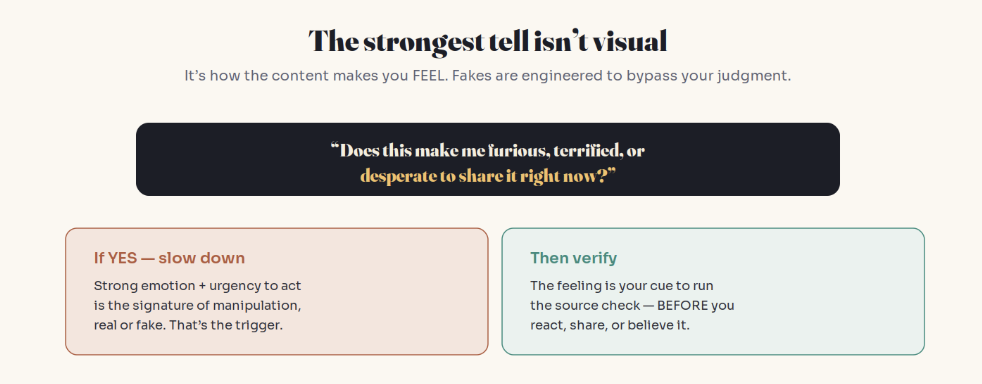
One method will never be patched, because it doesn't depend on the technology: does this make me furious, terrified, or desperate to share it this second? Fakes and manipulative content are engineered to flood you with emotion so you act before you think. Strong feeling plus urgency to act now is the signature of manipulation, real or synthetic.
The most reliable fake-detector you own isn't your eyes. It's the moment you notice you're being made to feel something urgently — and choose to slow down instead of speed up.
Flip the feeling into a trigger: the instant content spikes your emotions and pushes you to react, let that be the cue to stop and run the source check — not to share.
This isn't about becoming paranoid
The answer to convincing fakes isn't disbelieving everything — that's its own trap, because someone can dismiss a real inconvenient truth as "probably AI." The goal is a lightweight default of verify before you amplify, reserved for content trying to change what you believe, how you vote, or what you do with your money.
The goal isn't to trust nothing. It's to stop trusting things automatically — and to know exactly which 30-second check to run when it counts.
Key Takeaways
Visual tells (hands, teeth, lighting) no longer work; people detect high-quality fakes at ~55% — near chance.
The absence of an obvious flaw no longer means "real" — only "not a lazy fake."
Switch from checking pixels to checking source and provenance, which fakes can't easily fabricate.
Use Stop, Find, Check, Trace before believing or sharing anything consequential.
The strongest tell is emotional: content engineered to make you act now is your cue to slow down and verify.
FAQ
Can you still tell if an image is AI-generated by looking at it?
Often not reliably. Modern AI models have fixed the old tells — distorted hands, weird teeth, inconsistent lighting — and studies show people detect high-quality fakes at only about 55% accuracy, barely better than a coin flip. Visual inspection is no longer a dependable method; checking the source and context of the content is far more reliable.
How can I tell if a photo or video is real?
Run a quick source check instead of grading the pixels: Stop (pause before reacting), Find the source (who posted it first and where), Check other coverage (are credible outlets also reporting it), and Trace it back (reverse-image search, find the original or full clip). A fake typically has no traceable origin, while a real event appears in multiple credible places.
What is the biggest sign that content is fake?
How it makes you feel. Fakes and manipulative content are engineered to make you furious, terrified, or desperate to share immediately — flooding you with emotion so you act before you think. Strong emotion combined with urgency to act right now is the signature of manipulation, and it should be your cue to slow down and verify rather than react.
Do the old tricks like counting fingers still work for spotting AI images?
Rarely. Counting fingers, checking teeth, and looking for lighting errors worked when image generators were crude, but modern diffusion models render anatomically correct hands, realistic teeth, and consistent lighting. Relying on these tells now creates false confidence — you see no obvious flaw and wrongly conclude the content is real. Source verification has replaced visual inspection.
Are AI detection tools accurate?
They can be a useful second step, but they're not proof. Automated AI-text detectors in particular are unreliable and frequently produce false positives, sometimes flagging human writing as AI. Treat any tool's verdict as one signal among several, not a final answer. For non-experts, checking the source and context remains the most dependable approach.
How do I stay informed without becoming paranoid about everything being fake?
Reserve your skepticism for content designed to move you — things trying to change what you believe, how you vote, or what you do with your money — rather than treating every image as suspect. Adopt a lightweight default of "verify before you amplify" and run the 30-second source check only when it matters. Blanket distrust is its own vulnerability, because it lets people dismiss real evidence as fake.
Related reading
Why AI Confidently Lies to You — the "sounds true, isn't" problem in AI text, a sibling to fake media.
Is ChatGPT Really Private? — another clear-eyed look at living alongside AI.
Why Everyone Can Tell Your Writing Is AI — spotting AI text, from the other direction.
The bottom line
The era where you could squint at an image and know is over, and no "look closer" advice is bringing it back. But that was never where your power was. Your power is in asking where something came from, whether it exists anywhere credible, and why it's trying so hard to make you feel something.
Stop grading the pixels and start investigating the source. Notice the emotional tug and treat it as a cue to slow down.
You'll never win the war on your screen by looking harder. You win it by asking better questions than the fake can answer.
I'm a software engineer who writes about AI for normal humans. Follow along for the next one.