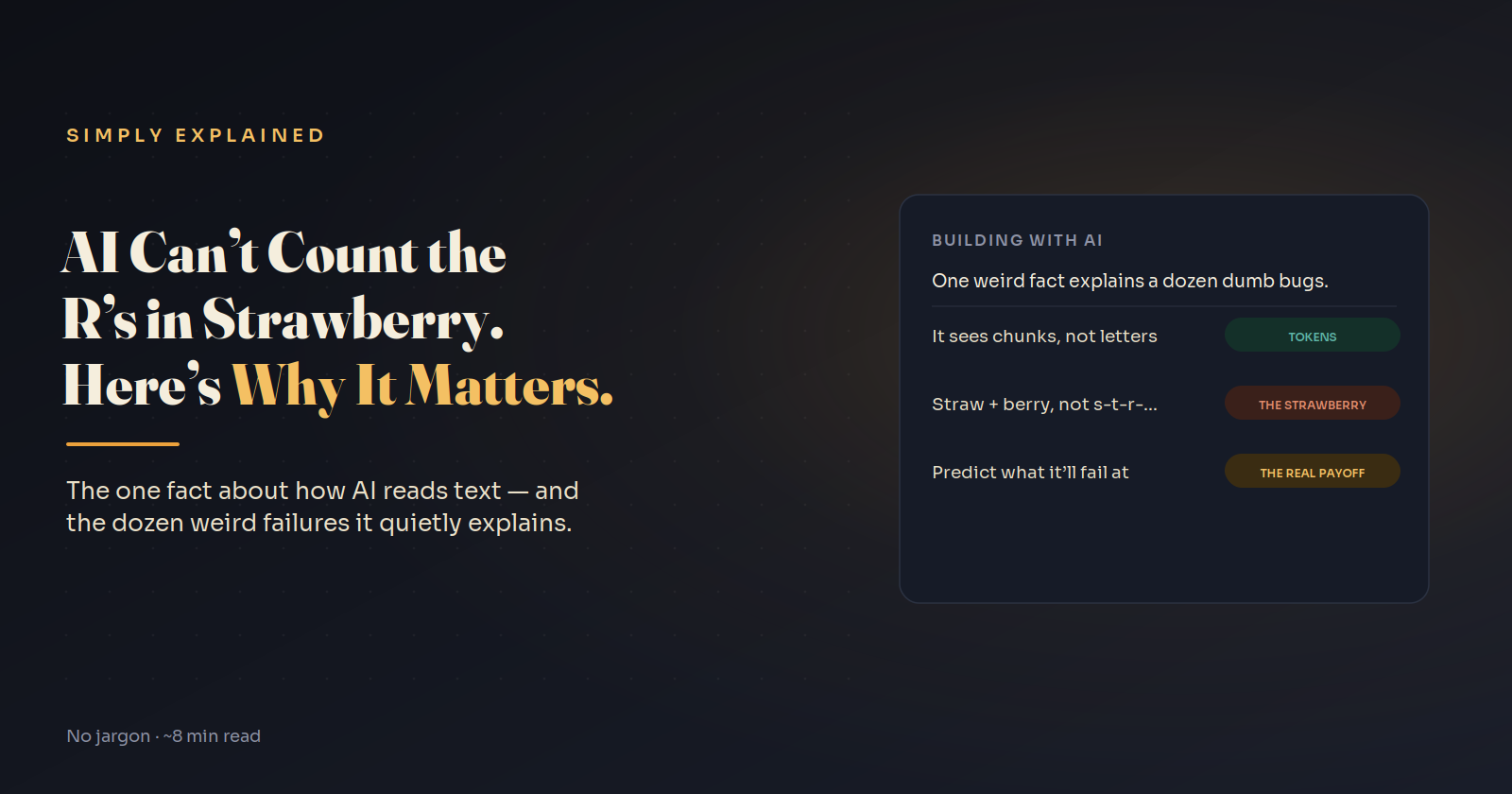
AI Can't Count the R's in 'Strawberry.' One Fact Explains Why — and a Dozen Other Bugs.
AI doesn't read letters — it reads chunks called tokens. That single fact explains the strawberry bug, bad math, wrong word counts, and more. Learn to predict AI's blind spots.
You've seen the meme: ask a brilliant AI how many R's are in "strawberry" and it says two. It's not a glitch, and it's not stupidity. It's a single fact about how AI reads text — and once you get it, you can predict half the dumb things AI does before it does them.
The same AI that can write a working program and explain quantum mechanics will confidently tell you "strawberry" has two R's. It has three. A five-year-old can count them; a system trained on much of human knowledge cannot.
Most people file this under "AI is dumb sometimes." That's the wrong lesson. The strawberry problem is a window into how these systems work, and the exact same fact explains a whole family of unrelated-looking failures: botched word counts, fumbled big-number math, broken rhymes, words it can't reverse.
The one fact: AI doesn't read letters
When you read "strawberry," you see ten letters in order: s-t-r-a-w-b-e-r-r-y. The AI never sees letters at all. Before processing, text is chopped into chunks called tokens — usually a common word or a fragment of one, not a letter. "Strawberry" becomes something like "straw" + "berry" (or "str" + "aw" + "berry"), and each chunk is swapped for an ID number. From then on, the model works only with those numbers.
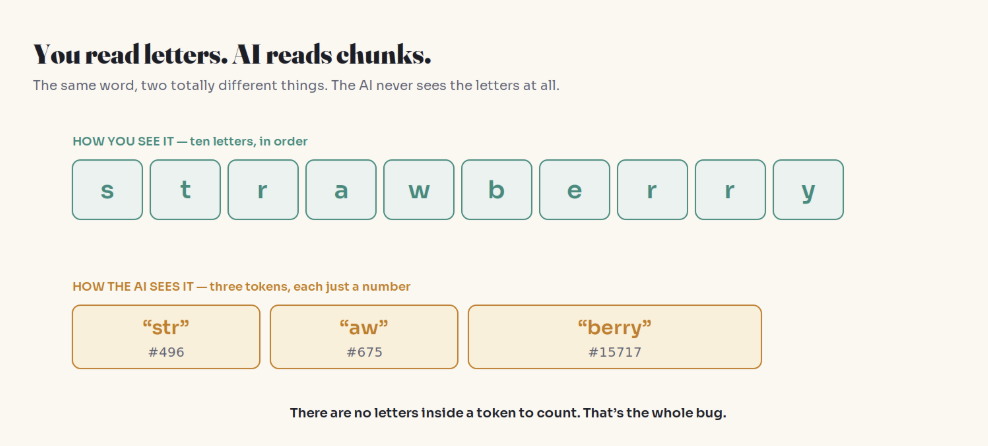
So the mystery dissolves. Asking "how many R's are in strawberry?" asks the model to look inside a chunk it can't see into. To the AI, "berry" isn't b-e-r-r-y — it's token #15717, an opaque tile with a number on it. There are no letters inside to count.
The AI doesn't see the word "strawberry." It sees a few numbered tiles. Asking it to count the letters is asking it to read something that, to it, was never written down.
When it answers "two," it isn't counting and failing — it's guessing the answer from training patterns, like guessing how many E's are in a word you've only heard spoken.
Why it's designed this way (not a mistake)
Tokens are a clever trade-off. If AI read individual letters, sequences would be enormously long and it would relearn spelling everywhere. If it read whole words, it would need millions of vocabulary entries and choke on typos and new words. Subword tokens are the sweet spot: common words become one tile, rare words split into reusable fragments, and ~100,000 tokens cover any text.
Tokens are why AI is so good with language and so bad with letters. The same design that lets it understand meaning is what blinds it to spelling.
The model was optimized to understand what words mean, not how they're spelled. Meaning lives at the token level; spelling lives below it, inside the tile, where the model can't look.
The payoff: predict AI's weak spots
Once you know AI can't see below the token, a family of "why is it so bad at this?" behaviors makes sense — and you can anticipate them. They share one signature: any task requiring individual letters, characters, or exact counts is one AI is structurally bad at.
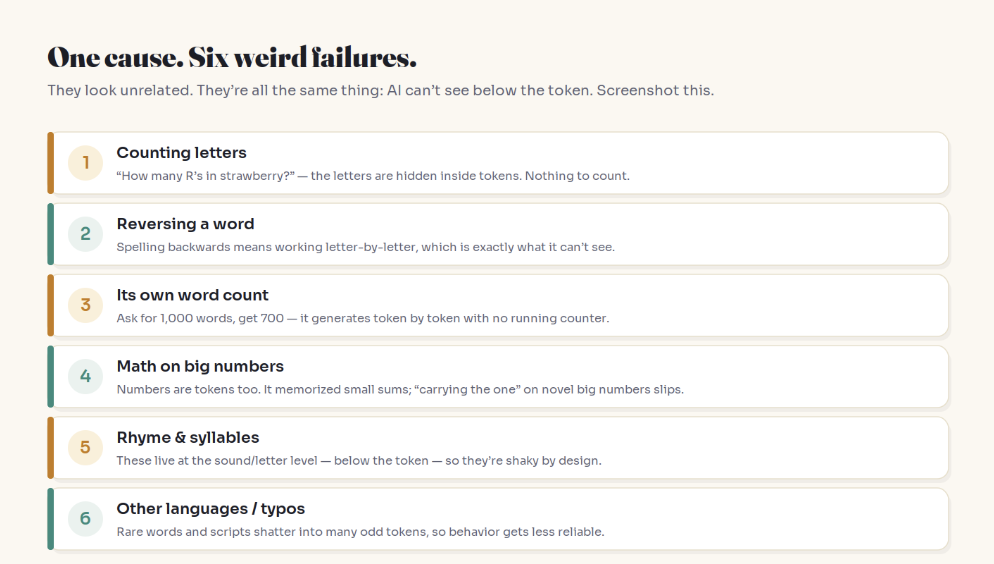
Counting letters — the strawberry itself; letters are locked inside tokens.
Reversing a word — a pure letter-by-letter operation, exactly what tokens hide.
Its own word count — ask for 1,000 words, get 700; it generates token by token with no running counter.
Big-number math — numbers are tokens too. It "knows" small sums from training but slips on novel large ones needing digit-by-digit carrying.
Rhyme and syllables — these live at the sound/letter level, beneath the token.
Other languages and typos — text the tokenizer wasn't optimized for shatters into odd tokens, reducing reliability.
These six failures look unrelated. They're the same bug wearing six costumes — every one lives below the token, where the AI cannot see.
The rule that predicts them all: if a task depends on individual characters or exact counting, don't trust the AI to do it in its head.
How to get around it
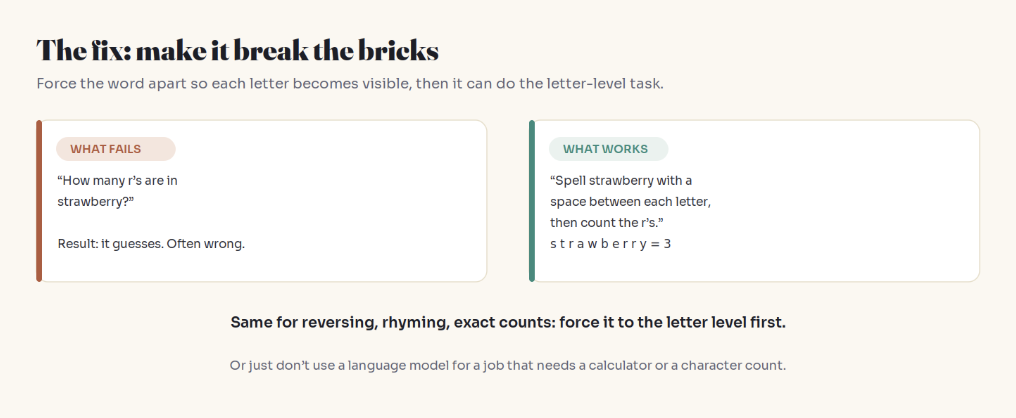
Force the brick apart. When you need a letter-level task, make the model spell the word out before operating on it. Instead of "how many R's are in strawberry?", ask: "Spell strawberry with a space between each letter, then count the R's." Writing "s t r a w b e r r y" turns each letter into its own token — now visible and countable.
The same works for reversing (spell it out first), rhyme (sound out the ending), and exact counts (break it into an enumerable list). And the simplest fix: don't use a language model for a job that needs a calculator. For precise math or exact counts, use a real tool — many AI systems now do this automatically.
AI is brilliant with meaning and clumsy with characters, because it reads chunks, not letters. When a task lives at the character level, force the letters open or hand the job to a real tool.
Key Takeaways
AI reads tokens (chunks of text as ID numbers), not individual letters — so it can't "see" spelling.
The strawberry bug happens because letters are hidden inside tokens; the model guesses instead of counting.
Tokens are an efficient design optimized for meaning, not spelling — a feature and the bug at once.
One cause explains many failures: letter counts, reversing words, word counts, big-number math, rhyme.
The fix: force the word apart (spell it letter by letter first) or use a real tool for exact counting/math.
FAQ
Why can't ChatGPT count the letters in "strawberry"?
Because it doesn't read letters. Before processing, text is split into chunks called tokens — "strawberry" becomes something like "straw" + "berry," each replaced by an ID number. The individual letters are hidden inside those tokens, so there is nothing for the model to directly count. Instead of counting, it guesses the answer from patterns in its training, which is why it often gets it wrong.
What is a token in AI?
A token is the basic unit of text a language model processes — usually a common word or a fragment of one, averaging about ¾ of a word. Before the model does anything, your text is broken into tokens and each is converted to a number. The model works entirely with these numbered chunks and never sees the raw individual letters, which is why character-level tasks are hard for it.
Why is AI bad at math?
Because numbers are tokens too, not digits it manipulates step by step. The model reliably "knows" small sums it saw frequently in training, but large or novel calculations require precise digit-by-digit carrying — a character-level operation it isn't built for. It pattern-matches numbers rather than truly calculating, so it slips on big or unusual ones. For exact arithmetic, use a calculator or a tool-enabled AI.
How do I make AI count letters or characters correctly?
Force the letters into view before asking it to count. Instead of "how many R's are in strawberry?", ask it to spell the word with a space between each letter and then count — for example, "Spell strawberry letter by letter, then count the R's." Writing out "s t r a w b e r r y" makes each letter its own token, which the model can then enumerate accurately.
Why does AI get my requested word count wrong?
Same root cause as the strawberry bug. The model generates one token at a time with no running word counter, so it cannot track its own output length. Ask for 1,000 words and you may get 700 while it insists it hit the target. For an exact length, count the result yourself or use a tool rather than trusting the model's self-reported count.
Is the strawberry problem a sign that AI is not intelligent?
No — it's a sign that AI's intelligence has a specific shape. The model is optimized to understand meaning, which lives at the token level, not spelling, which lives below it. Failing a character-counting task doesn't reflect general stupidity; it reflects operating at a different resolution than the question assumes. Understanding this shape is what lets you predict where AI will and won't be reliable.
Related reading
Why AI Forgets What You Said — the context window, measured in these same tokens.
How RAG Works — feeding AI the right context, built on tokens.
Why AI Confidently Lies to You — another predictable failure mode of pattern-based models.
The bottom line
AI can't count the R's in strawberry because it never sees the R's — it reads the word as a few numbered chunks optimized for meaning, with the letters sealed inside. That single fact (AI reads tokens, not characters) turns a whole category of baffling, confident failures into something you can see coming.
Stop being surprised that a genius can't count to three. Start seeing the shape of the mind you're actually talking to — chunks, not letters, all the way down.
I'm a software engineer writing about AI and the systems behind it, minus the jargon. Follow along for the next one.