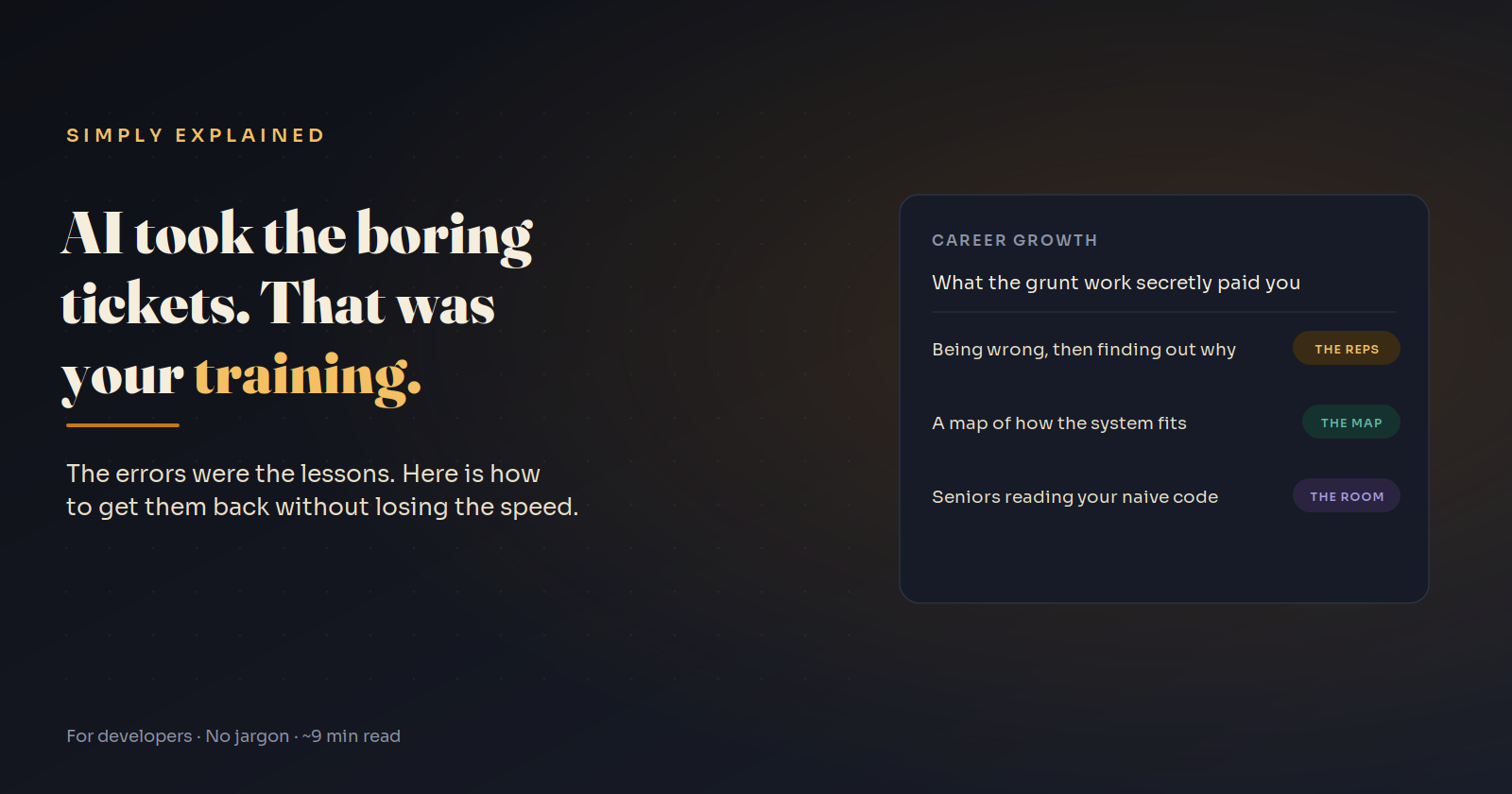
AI Took the Boring Tickets. That Was Your Training.
The errors were the lessons. Here's how junior developers get them back without giving up the speed.
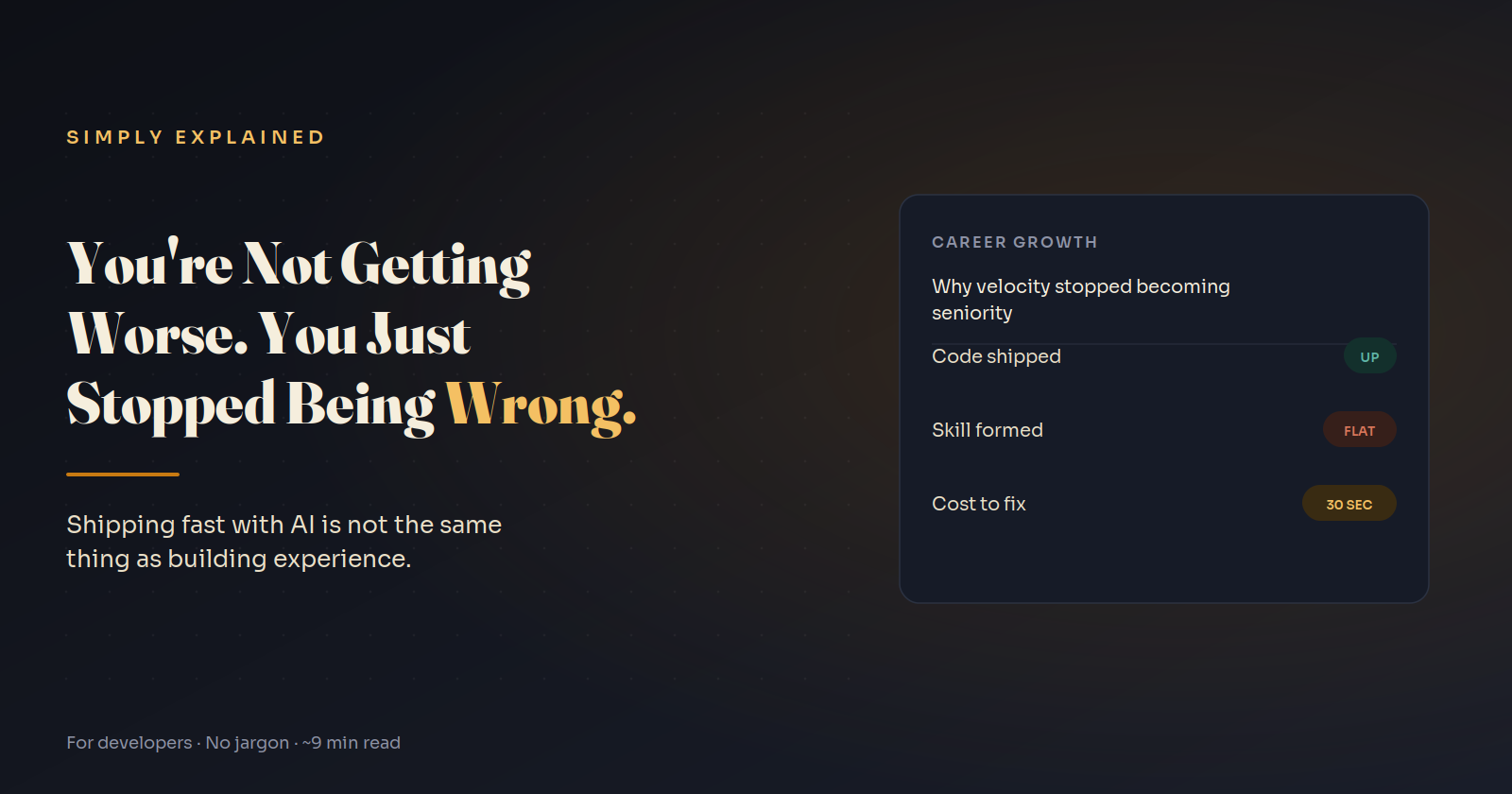
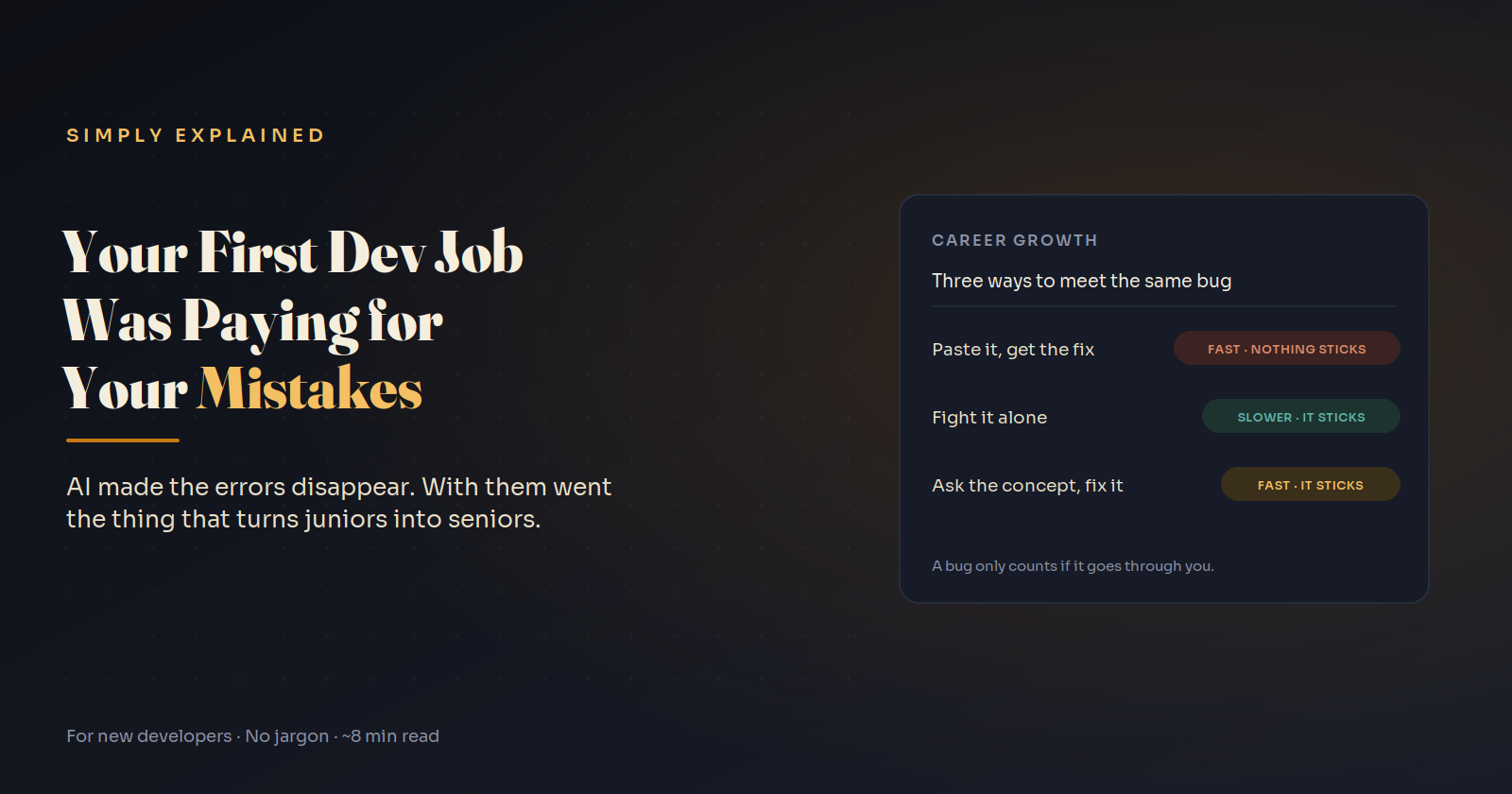
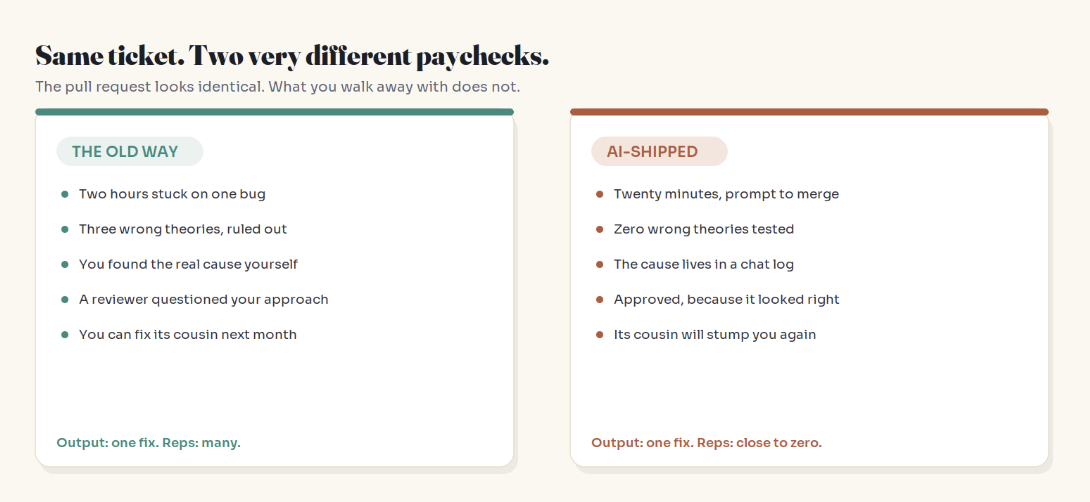
Your first real bug: a date shows up one day off for users in one timezone. Two hours, three theories, two of them wrong, and a senior's review comment that makes you rewrite half the fix. Today the same ticket takes twenty minutes with an AI assistant.
The company wins that week. You might lose the next ten years. This piece explains why, using what the research actually shows, and gives you five habits to fix it.
Key Takeaways
Junior "grunt work" was a hidden curriculum: you were paid to be wrong where being wrong was survivable.
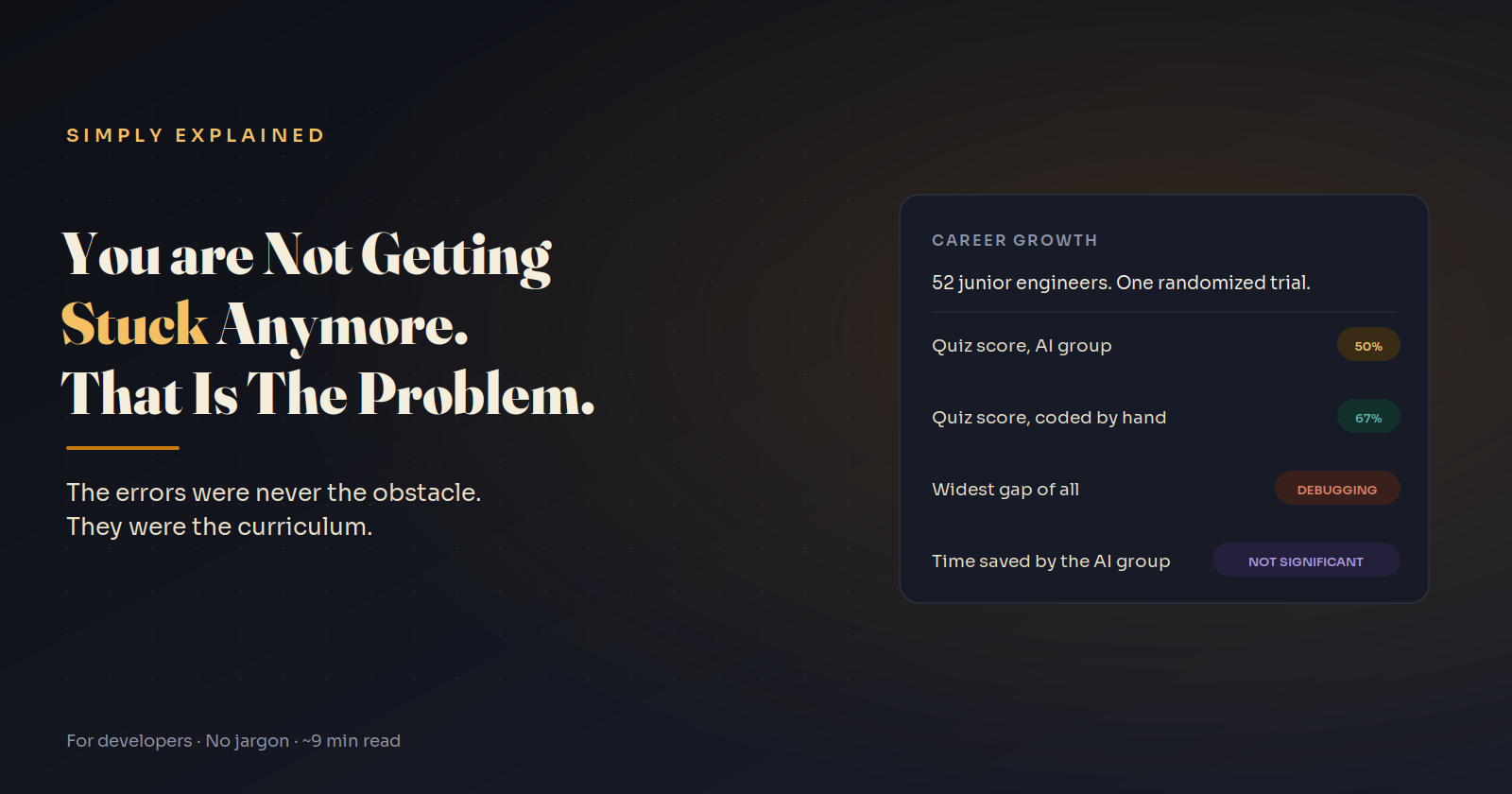
In Anthropic's January 2026 randomized trial, 52 mostly junior developers learning a new Python library scored 50% on a follow-up quiz with AI help versus 67% by hand, with the biggest gap in debugging.
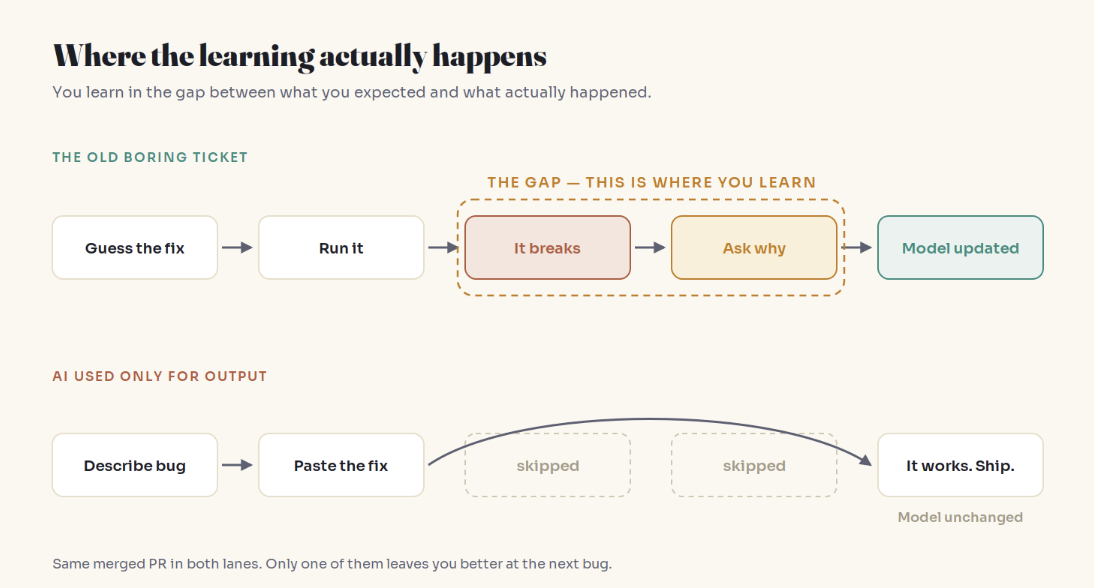
The mental model: you learn in the gap between what you expected and what happened. AI used only for output closes that gap before it opens.
Boring tickets paid in three currencies: the reps, the map, and the room.
The fix isn't abandoning AI. It's using AI for understanding, and manufacturing the reps on purpose.
Why boring tickets mattered for junior developers
The junior queue was always full of low-stakes work: small fixes, boilerplate, tests, sprawling migrations. It was cheap enough to hand to someone who would get it wrong a few times. The ticket was the excuse; the training was the product.
AI is very good at exactly that work, so it's leaving junior queues. Entry-level developer hiring has dropped sharply since 2022 by most measures, but even juniors who do get hired face the quieter problem: if the boring tickets were your training, who trains you now?
What the research says about AI and coding skills
Anthropic's trial had developers learn Trio, an unfamiliar Python library, with or without an AI assistant that wrote correct code on demand. Everyone then took a quiz without AI. The AI group averaged 50%, the hand-coding group 67%, and debugging showed the largest gap. The AI group was only slightly faster, and not by a statistically significant margin.
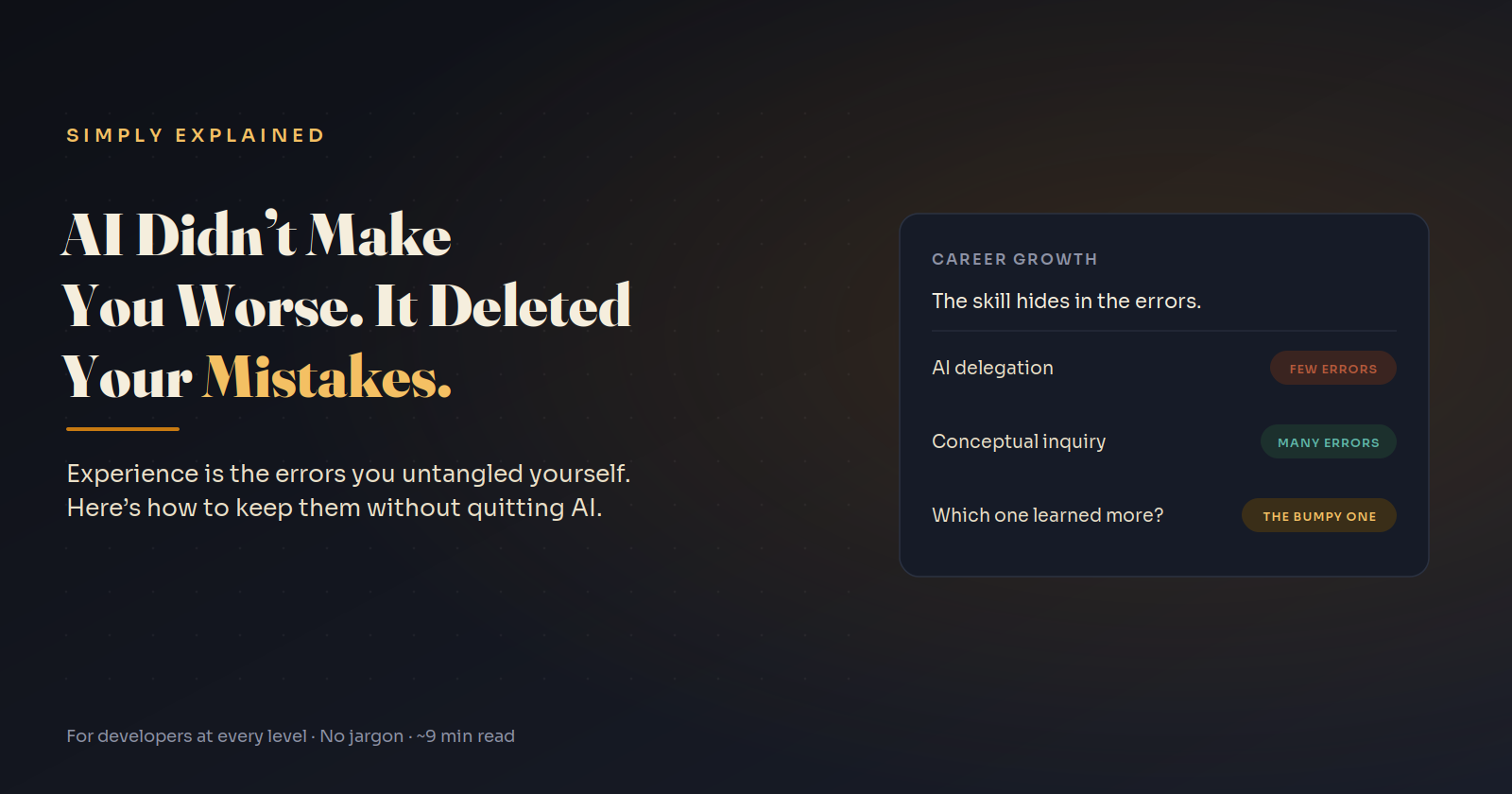
The telling detail: the hand-coding group hit more errors, many about the exact concepts on the quiz. The researchers' hypothesis is that working through those errors helped the concepts stick. A Seoul National University interview study published in September 2026 describes the same pattern: as AI absorbs junior tasks, it removes the opportunities to fail that used to produce seniors.
The errors weren't in the way of the lesson. The errors were the lesson.
The learning gap: a mental model for developers
You guess, you run it, it breaks, and now you have a question you care about: why? Answering it updates the model in your head. Use AI purely for output and that gap never opens. The pull request is identical; you are not.
The three things grunt work taught you
The reps. Being wrong and finding out why. Seniors aren't people who stopped making mistakes; they've already made thousands and remember the shape of each.
The map. Scattered tickets sent you through config files, queue consumers, and forgotten reports until you knew how the whole system fits together.
The room. Your naive code landed in front of seniors who pushed back. Clean AI code gets approved, and the conversation disappears.
AI-shipped work pays you in output. Struggle pays you in reps. Only one of them compounds.
How junior developers can rebuild skills while using AI
Nobody will schedule time for you to be confused. So take it:
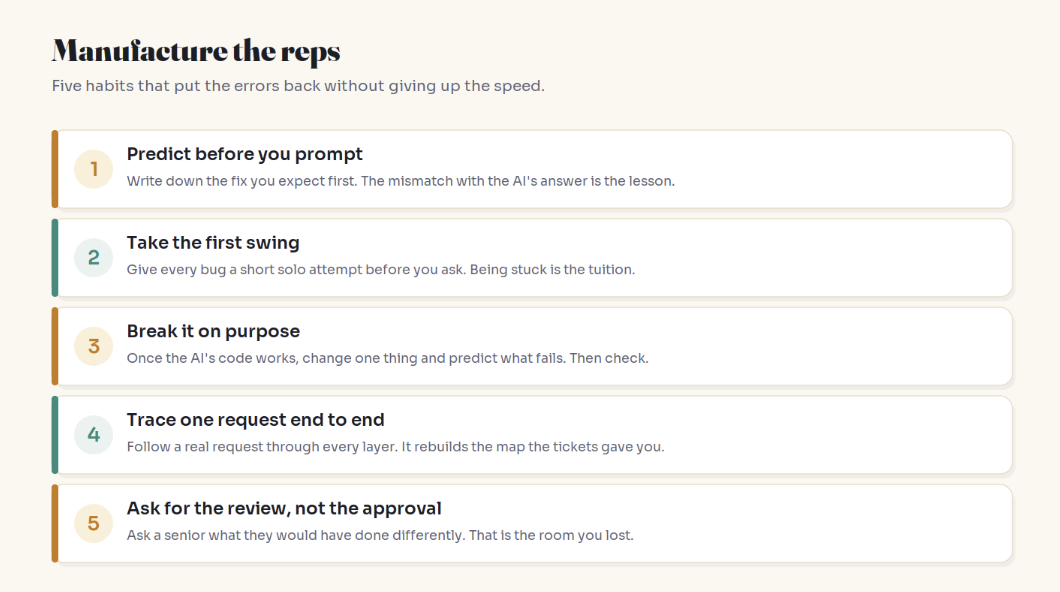
Predict before you prompt. Write one line with your expected cause or fix, then ask. Disagreement recreates the gap.
Take the first swing. A short, honest solo attempt, around fifteen to twenty minutes, so you have a theory to compare against.
Break it on purpose. Change one thing in working AI code and predict what fails. It's cheap debugging practice, the skill that dropped most in the study.
Trace one request end to end. Weekly, follow a real request through every layer. It rebuilds the map.
Ask for the review, not the approval. Explain every change in your own words, then ask a senior what they'd have done differently.
This isn't anti-AI
In the same study, using AI didn't guarantee a low score. High scorers used it to understand: follow-up questions, explanations, concept checks. Low scorers delegated the thinking. The line is output versus understanding, not AI versus no AI. On Fridays, ask: what did I get wrong this week, and do I know why?
FAQ
Is AI bad for junior developers' learning?
Not inherently. Anthropic's 2026 trial found AI users scored lower on average when learning a new library, but participants who used AI to ask questions and request explanations retained much more than those who delegated the code entirely.
Why does debugging skill suffer most when using AI?
Debugging is built from experience with errors. When AI produces working code immediately, you encounter fewer errors, so you get fewer chances to practice diagnosing them. Debugging showed the largest gap in the study.
How long should a junior developer try before asking AI for help?
A short, honest attempt of roughly fifteen to twenty minutes is enough to form your own theory. The point is having a guess to compare with the AI's answer, not struggling for its own sake.
What skills did junior developer grunt work teach?
Three things: repeated practice at being wrong and finding out why (reps), knowledge of how the whole system fits together (the map), and feedback from senior engineers reviewing imperfect code (the room).
Should junior developers stop using AI coding assistants?
No. Use them for understanding rather than only output: predict before prompting, break working code on purpose, and make sure you can explain every change you ship.
Does this apply to senior developers too?
Yes, whenever they learn something unfamiliar. The trial studied learning a new library, a situation every engineer returns to throughout a career.
Related reading
AI Won't Take Your Coding Job. It Will Change It. (the job is shifting toward verification and judgment)
How to Let AI Think for You Without It Thinking for You
AI Writes Code That Looks Right
Start Here: the Simply Explained reading path
The bottom line
AI took the boring tickets, and with them the thing they were quietly doing: letting you be wrong often enough to get good. You can keep the speed and the growth, but only on purpose.
The industry removed your training by accident. Put it back on purpose.
Adam Jaber is a software engineer who writes Simply Explained: complex topics, made simple, with no jargon and no hype.